As AI Reshapes Work, What Happens to Health Benefits?
How the labor pool is shifting, and where we’re investing

“Cancer is cured, the economy grows at 10% a year, the budget is balanced — and 20% of people don’t have jobs.”
Dario Amodei, CEO and co-founder, Anthropic
“The U.S. and other rich countries will run out of workers before we run out of jobs.”
David Autor, MIT Professor of Economics
From economists to entrepreneurs, very smart people have offered very different takes on how AI will impact the future of jobs. But one thing is clear: the work we do, the titles we hold, and the shape of our days will be quite different.
Less discussed is what all of this means for our health. For most Americans, a job is also how we get health insurance. As AI affects who works and how, what happens to who gets covered, what that costs, and who foots the bill?
Today, roughly 80% of adult U.S. workers under age 65 work for an employer that offers health insurance. Many of the largest employers self-fund, paying employees’ medical bills directly from their own balance sheet rather than paying an insurance company a fixed premium to take on that risk. Currently, 67% of covered workers are on self-funded plans.
Health insurance is one of the largest expense lines for many companies. The average cost of employer-sponsored coverage is expected to exceed $18,500 per employee in 2026, and is expected to jump 8.2% next year — the biggest increase since 2003.
With the chatter about AI replacing human workers, it’s tempting (and a bit reductive) to assume a smaller workforce means a smaller bill. The reality is more nuanced. The bigger story is how a major labor shift will affect who is in the risk pool, what they need, and how fast that pool turns over. It also raises two questions: Does the classic self-funded model, built for a large, stable, predictable group of employees, still make sense? And could the same technology reshaping the workforce also make self-funding smarter and cheaper to run?
Here’s what we’re keeping an eye on.
Who is in this pool?
1. An aging workforce and shrinking entry-level, junior roles.
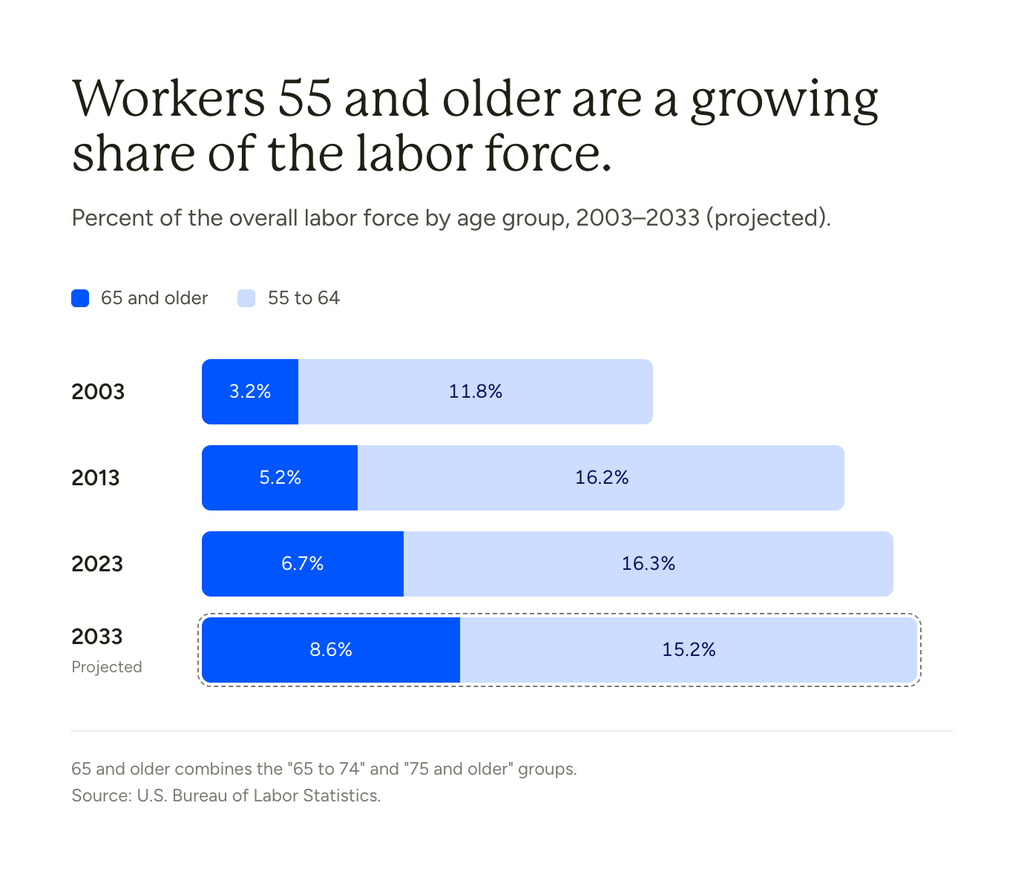
Workers 65 and older now make up nearly 7% of the labor force, more than double the share two decades ago. At the other end, the population of 16-to-24-year-olds is projected to shrink 6% by 2034, and the number of them in the labor force will fall even faster, by 10%. In other words, there will be fewer young people, and a smaller share of them working. Research suggests AI is thinning the hiring pipeline for junior positions.
For employers, this translates to an older pool, which challenges a key ingredient that makes self-funding models work: a large and demographically balanced workforce where total medical spend is predictable — and, ideally, evens out. That happens when young, healthier employees with no or few claims offset peers with high ones. At the risk of sounding blunt, young lives are the most cost-efficient lives on any health plan. As the average age rises, so does cost per member.
One way to mitigate the rising costs is to tailor benefits to an aging workforce. Older employees with higher risk can benefit from chronic condition management (for diabetes, hypertension, heart disease, for instance), earlier cancer screening and navigation, menopause support, specialty pharmacy pricing, caregiver support, and transition planning.
But adding more benefits runs into a problem: point-solution fatigue. Large employers juggle around a dozen health vendors, and more than half say their employees aren’t using specific point solutions. The few that have been independently evaluated — mostly diabetes and hypertension apps — show modest clinical gains and little or no net savings. And those conditions aren’t even the biggest cost drivers. For the fifth year running, employers named cancer as the top condition driving their healthcare spending. The 1% of members driving 33% of the costs have needs that are episodic, high-acuity, and not easily solved with an app.
2. Deskless and frontline workers in hard-to-automate jobs will become a bigger share of the pool.
The largest U.S. deskless sectors include healthcare, retail, hospitality, manufacturing, construction and logistics, and many of their hands-on, skilled jobs will be hard to replace with AI. These workers will make up a larger share of the pool as more desk jobs get automated.
Healthcare, the country’s largest employment sector, offers a good case study. In our view, care will not be replaced by AI doctors anytime soon. Health systems are among the largest self-insured employers, and their per-employee health spend rose 9.2% in 2025 against 1.3% operating margins. Cost management has displaced staff retention as the top HR priority.
This changes the math of self-funding models in a different way than aging does. Frontline workers are mostly hourly, lower-wage, and high-turnover, and that matters on three fronts:
- Turnover undercuts the ROI on prevention: Programs that take three to 10 years to save money never pay off for an employee who leaves after one or two.
- Cost shapes behavior: Deductibles are frequently the same amount regardless of pay, so for a lower-wage worker, even a routine visit can feel unaffordable, and care gets put off until it turns into an ER visit.
- Health benefits are optimized for desk workers: Enrollment emails, portals and 2 p.m. appointments assume someone can step away, and many frontline workers can’t.
Health systems feel these problems acutely, and these are where we see promising opportunities for innovation:
- Domestic steerage. When the employer is also the provider, every claim kept in-house is partly paid back to itself. Designing plans that steer hospital workers to the system’s own clinicians can lower net cost, if the experience is good enough that staff want to be patients where they work.
- Pricing benefits against turnover, not just the benefits budget. Replacing a bedside nurse costs hospitals about $60,000, and reducing nurse turnover by even 1% saves the average hospital roughly $295,000 a year. A benefit that improves retention by a few points can pay for itself even if it never lowers claims.
- Designing for a multi-tier workforce. The same plan has to work for different staff working in different environments with different needs (i.e. physicians, nurses, frontline workers). A one-size-fits-all approach usually shortchanges one group. Fixes include premium contributions that scale with pay, and benefits that fit hourly work, such as musculoskeletal (MSK) care for physically demanding jobs and appointments that work around a shift schedule
Health systems aren’t alone. Retail, hospitality, logistics, and construction employers face the same challenges with even fewer tools, and the current benefits stack hasn’t been built around their workers.
How fast is the pool changing?
3. More voluntary job-switching and more layoffs
According to 2022 figures from the Bureau of Labor Statistics, workers ages 55 to 64 had a median tenure of 9.8 years — more than triple that of workers 25 to 34 (2.8 years). This gap predates today’s headlines about AI-driven layoffs. But between job-hopping, layoffs, and generational shifts in workplace loyalty, it’s likely that average employee tenure will be shorter in the future.
A shorter tenure weakens the ROI case for preventive spend. Spending on GLP-1s, chronic disease programs, and MSK prevention only pays off if the employee stays long enough for the savings to show up. If the workforce turns over faster, employers may cut preventive programs that take five or more years to pay back.
Layoffs and involuntary turnover pose a different problem. Laid-off workers can stay on their employer’s self-funded plan through COBRA. These enrollees tend to be the ones who expect to need care, and their claims run high. Losing a job is one of the hardest moments in American life, both financially and medically, and available remedies are thin: mostly COBRA and outplacement services. The opportunity is in prevention that pays back within a typical tenure, benefits that follow a worker from job to job, and better ways to manage COBRA costs.
4. Some companies will grow headcount more slowly
As AI becomes more capable of doing work that used to require people, some companies are growing rapidly without adding headcount at the same pace. (“Revenue per employee” has become a favorite metric among AI-native startups.) A company that once might have grown to 5,000 employees now may top out at a few hundred.
Smaller, more varied workforces strain self-funding in two ways. The first is size. Because a small share of members drives most of the costs, self-funding only works when there are enough people to absorb those few expensive claims. In a smaller pool, a single cancer diagnosis can swing a company’s health spending dramatically. That may push some employers to buy more stop-loss coverage (insurance that kicks in when claims get too big), or to give up on self-funding altogether. The second is shape. The single group plan was built for a stable workforce of full-time employees in one place, and fewer companies look like that.
The market is already adjusting. Under an individual coverage health reimbursement arrangement (ICHRA), employers give workers a tax-free allowance to buy their own health plan on the individual market, so the employer no longer carries the risk of big claims. Employers can set different amounts for different groups: full-time versus part-time, salaried versus hourly, or by location. Large employers are taking this up: ICHRA adoption among companies with 1,000 or more employees grew 178% over the past year. Rather than a premium plan for some workers and a basic one for others, the likely future is benefits designed around how people actually work.
However, running more than one benefits structure is still messy and manual, with separate carriers, enrollment, and compliance checks for each class. We see opportunity for tools that manage it all seamlessly.
5. AI also makes self-funding cheaper and smarter to run.
Self-funded employers are also fiduciaries for their plans. But seeing whether what they’re getting is worth the cost involves disparate, expensive, and manual processes: periodic pharmacy benefit manager audits, sampled claims reviews, and a steady stream of consultants.
AI tools make it much cheaper to review every claim, catch overcharges, and see whether programs are paying off. For the many employers large enough to self-fund, oversight goes from a periodic laborious project to something that runs continuously.
One interesting shift we’re watching is the rise of cash pay. Price transparency rules made hospitals publish their cash prices, and they’re often lower than what plans pay. A Johns Hopkins study of 2,379 hospitals found cash prices were below the median commercial negotiated rate 47% of the time, which means a self-funded employer can end up paying more for a procedure than someone paying cash at the same hospital. Pricing data is massive and messy, but AI is making it easier to spot discrepancies. The hard part is operational: getting members to that care, paying for it, and making sure it counts toward their deductible.
That’s one of the many layers that Goodbill, a Reach portfolio company, is working on. Goodbill gives self-funded employers, and the TPAs, health plans, and brokers that serve them, the navigation, pricing, and payment infrastructure to get members to fair-priced care, including cash.
Building for the new risk pool
Whatever the workforce looks like in 10 years, the risk pool will look different from today’s. Running through every force above are two threads: growing costs and a changing insured pool. We expect employers to evolve from acting only as insurers to also acting as curators of their employees’ health, choosing the right mix of benefits for each group, steering people to good care at fair prices, and keeping closer watch on what they’re paying for.
If you’re building for that shift, we’d love to hear from you.
Read the Latest
News and Insights