Where the Edtech Backlash Is Missing Nuance
Part 2 in our series on the Edtech Backlash. Read Part 1 here. Or skip ahead to Part 3.
When calculators were first introduced in schools in the early 1980s, teachers picketed, fearing students would become “dependent on batteries instead of brains.” Later, with Wikipedia, YouTube and now AI, many districts blocked them before reversing course.
Every time a new technology makes its way into schools, adults ping-pong between fear of all the bad things students may do, and hope for all the good things they can accomplish.
And almost every time, one proposed solution emerges: ban it.
Over the past 18 months, dozens of state-level bills have been introduced to limit the use of technology in classrooms. They range from measured restrictions — limiting screen time in kindergarten — to sweeping bans. One bill in Kansas proposed making all elementary-school materials print-based. Another in Tennessee would have prohibited devices and assessments for grades K-5. Although neither passed, the drumbeat for prohibition is growing louder.
As we noted in our series opener, the current backlash is responding to real concerns about screen time, passive learning, mental health, and the loss of social connection at the heart of good teaching and learning. School lawsuits against big tech companies revealed that they knew about the addictive and distracting features deployed during school hours, and failed to address them. The impact of smartphones on adolescent well-being warrants serious responses, even as early research on school phone bans has shown mixed results on student academics and behavior.
A big risk in this debate is conflating all of “edtech” into one thing that must be accepted or rejected wholesale. In reality, the tools schools rely on serve vastly different purposes, and not all belong in the same policy conversation. As we consider what to restrict, let’s be precise about what is actually in question.
Not All ‘Edtech’ Is Equal
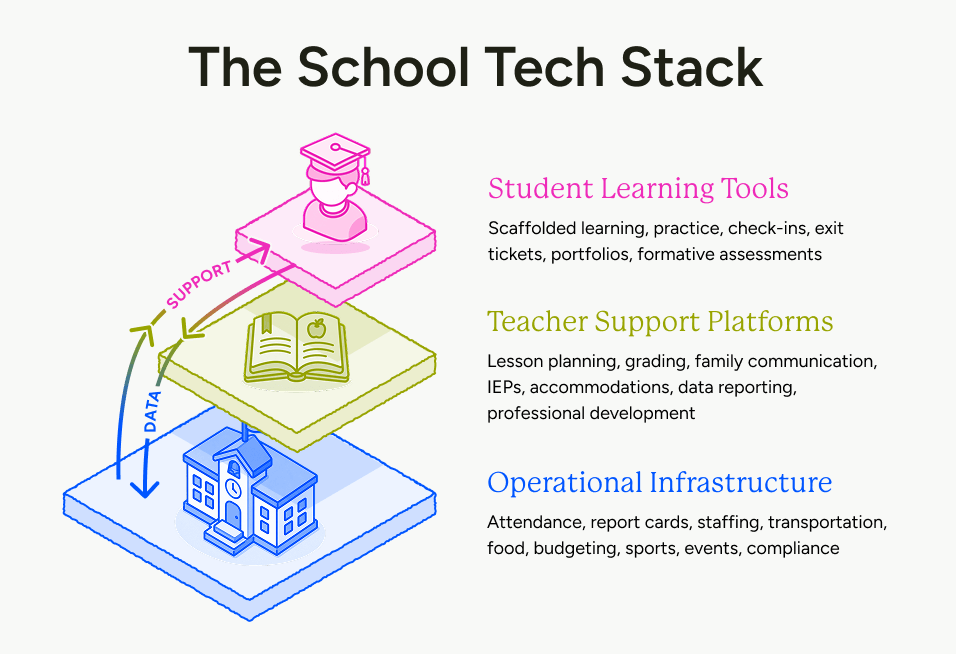
There are many layers in the technology stack that allows schools and districts to function, and collapsing them all into a single policy conversation risks breaking more than it fixes.
Operational Infrastructure
This first layer are the systems that track attendance, bell schedules, grades, transportation, health services, extracurricular activities, and the growing range of supports that schools are now expected to provide. Much of this lives in student information systems — the operating system of everyday school and district life — and are essential to meeting funding and compliance requirements.
Most students never touch these systems directly. But these systems depend on data from student-facing tools to function. Creating IEPs for special-needs learners draws on data and documentation from multiple systems, including student assessments. Digital screeners like DIBELS and mCLASS flag students who need reading intervention. Survey tools like Panorama let students report their wellbeing, helping counselors identify which ones need support. Some of these check-in tools serve as proxies for attendance, which has implications for state funding.
Especially at a time when central office budgets have been cut significantly, these tools allow leaner district teams to keep serving schools without dropping the ball on compliance, funding, or student support.
Teacher Support Platforms
The second category are platforms that help teachers manage lesson planning, grading, family communication, and data reporting. Teachers work well over 50 hours per week, on tasks that often happen outside the classroom — a reality that some of us at Reach know firsthand as former educators. It’s why we’ve invested heavily in this category, in tools like TeachShare that help teachers create differentiated, standards-aligned instructional materials and formative assessments in minutes.
Teacher tools can also enrich the student learning experience. Curipod lets teachers design lessons and facilitate small-group discussion activities that have been shown to improve reading and writing outcomes. TeachFX analyzes classroom dialogue to help teachers improve their class instruction, which has led to more student talk time, particularly among English language learners and others who get fewer opportunities to speak.
Student Learning Tools
This is where the brunt of the edtech backlash is happening, and some of it is well-deserved. Student-facing edtech that amount to little more than rote, digitized worksheets deserve scrutiny, especially when they are used as substitutes for student-teacher relationships. But individual practice is part of learning, too. When done well, these tools inform, not replace, teachers. Formative assessments and exit tickets provide valuable real-time signals about what students understand and don’t.
For every iReady, there are student-facing tools that students, teachers, and parents love. Desmos is one of the most popular and beloved tools, allowing students to explore math through creative expression — one of many tools that make content more engaging, accessible, and responsive to student levels and interests. The problem is not the category itself, but the quality of how these tools are designed and used.
All of these tools feed upstream into school operations in ways that aren’t always visible. In this challenging school funding climate, the desire to unplug what’s not working and simplify the stack is understandable. But doing so indiscriminately risks destabilizing the intricate systems schools depend on to function.
Blunt Instruments Don’t Land Evenly
With blanket restrictions, the students who stand to lose most are the ones who have no other access to begin with. Whether it’s calculators or computers, well-resourced students have always found workarounds. As recently as 2024, ACT found that the digital divide persists: 92% of students from high-income families have laptops at home, versus 76% of those from lower-income households
Even teachers who are scaling back tech are wary of bans. “I believe teachers do their best work when they’re trusted as professionals,” said middle-school math teacher Dylan Kane, who has written about going tech-free for a month. “I get very nervous about mandates and things that can feel very blunt and erode teacher judgement.” It’s a sentiment echoed by students. “Many decision-makers haven’t experienced technology in learning at this scale,” a student panel told New America. “Without that lived experience, they often miss its nuances and how it can support student learning.”
Nuance is what this moment calls for. Technology has always scaled the bad along with the good; the challenge is figuring out which is which. It turns out behavioral science offers practical guidance that’s more actionable than most of this debate has acknowledged. That’s where we’ll go next.
*Curipod, Desmos, TeachFX and TeachShare are Reach portfolio companies.
Read the Latest
News and Insights