Metabolic Health and Allergy: 2 Routes to Family-Based Pediatric Care

In Part I, we outlined how the next category-defining pediatric health company will treat the family — not only the child — as the clinical unit. The most durable versions of this model will begin with a specific condition where family participation is clinically consequential, then expand into adjacent needs connected by shared biology, household behaviors, or care infrastructure.
We’re actively exploring two promising wedges for building this platform from different points on the evidence-maturity curve: pediatric metabolic health, where the protocol is established and reimbursement is catching up, and pediatric allergic disease, where the household is already central to care but family-based protocols are still emerging.
Route A: Pediatric Metabolic Health
Pediatric obesity affects approximately 1 in 5 U.S. children, at a cost of $14 billion annually. Four decades of Epstein’s research established that pediatric obesity is a family-systems problem with a family-systems solution.
Until recently, the reimbursement infrastructure for family-based obesity treatment did not exist. That is changing:
- The AAP’s 2023 clinical practice guidelines explicitly named intensive family-based behavioral treatment as the first-line therapy for pediatric obesity — 26+ hours of multidisciplinary family-based intervention over 3–12 months.
- The 2024 Medicare Physician Fee Schedule activated new CMS billing codes that make clinical work with parents directly billable for the first time. As of 2025, these codes are telehealth-eligible.
- Commercial insurance is now required to cover the treatment. The U.S. Preventive Services Task Force — the federal panel whose evidence recommendations trigger ACA coverage mandates — endorsed intensive behavioral treatment for children with obesity. Commercial plans must now cover it without cost-sharing. The Supreme Court upheld the mandate in 2025.
- GLP-1 authorization requirements have changed the economics. Insurance historically balked at paying for pediatric weight treatment because the savings only showed up years later. Now, with adolescent GLP-1 drugs like Wegovy covered by insurance, pharmacy benefit managers increasingly require behavioral program enrollment before authorizing coverage, because behavioral treatment can meaningfully reduce expensive drug utilization within the first year.
There is also a structural shift in payor incentives that hasn’t been fully priced in. In 2025, 67% of covered U.S. workers were enrolled in self-funded health plans, up from 33% in 2000. Unlike traditional insurance carriers that lose members to churn within 2–3 years, self-insured employers bear direct claims risk for their workers’ dependents and may have a longer time horizon for realizing the benefits of preventive care. That provides a financial incentive to invest in children’s health that other payors have historically lacked.
Combined with multi-year, continuous Medicaid and CHIP eligibility in several states, the durable buyer for pediatric prevention looks structurally different than it did five years ago.
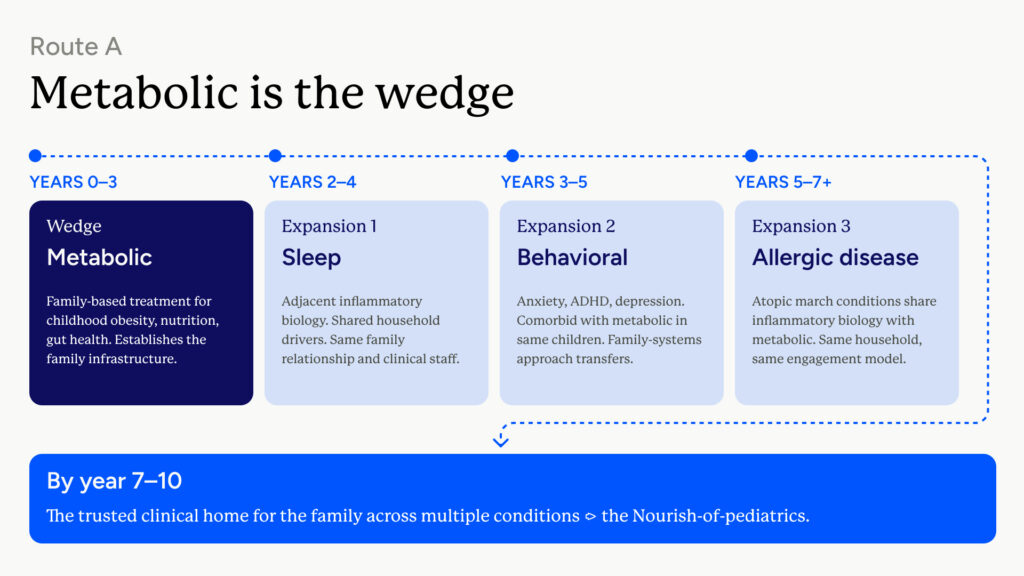
Pediatric metabolic health offers a promising wedge into a broader platform because the same household drivers behind pediatric obesity shape adjacent conditions. Poor sleep worsens insulin resistance, obesity drives sleep apnea, and anxiety often clusters with emotional eating. The gut microbiome, shaped by shared household diet, links metabolic health with atopic disease.
The clinical infrastructure a family metabolic company builds — the longitudinal family relationship, household-level data, parent-coaching workflows, and multidisciplinary care team — can therefore carry into related needs. The specific expansion path depends on the family panel a company builds and the comorbidity signals it observes. The sequence below is illustrative, not prescriptive.
Route B: Pediatric Allergic Disease
If metabolic health offers an opportunity to scale an established family-based protocol, pediatric allergic disease offers an opportunity to help build one.
Much of allergic-disease treatment already happens in the household. Oral immunotherapy dosing happens at home, sometimes for years. Asthma trigger management is home-based. Eczema treatment adherence depends on daily parental application of emollients and topicals.
The evidence for family-inclusive care in allergic disease is real but less developed than Epstein’s obesity research. Multiple RCTs show that parent education can reduce atopic dermatitis severity, while family-inclusive asthma interventions improve asthma control and children’s self-management while reducing parental stress. Food allergy has a thinner evidence base, with most RCTs focused on parental psychosocial outcomes rather than clinical outcomes such as adherence or reactions.
Because family-based protocols are still emerging, entrepreneurs have an opportunity to set the standard. Just as Equip Health generated outcomes evidence as it scaled the Maudsley model for eating disorders, a founder in pediatric allergic disease could become both the operator and evidence-generator for the category.
Three properties also make the wedge compelling on its own terms. First, demand is intense: parents managing pediatric food allergy live with daily anxiety about accidental exposure, and incur over $4,000 per child per year in combined direct and indirect costs. Second, outcomes — including eczema improvement, asthma control, and oral immunotherapy progress — can be measured within weeks.
Third, the addressable population is enormous. Eczema, food allergies, asthma, and allergic rhinitis are distinct but related atopic conditions that frequently cluster and appear at different ages in the same children and families. (Clinicians call the pattern the atopic march.) Together, these conditions affect tens of millions of U.S. children.
Several recent shifts have made pediatric allergic disease specifically investable in ways it wasn’t several years ago:
- Palforzia’s approval expansion to ages 1–3 in July 2024 opened up oral immunotherapy for toddlers, the age window with the highest desensitization success rates. This dramatically grows the addressable population and shifts the clinical model toward earlier, higher-leverage intervention.
- Xolair’s FDA approval for food allergy in February 2024 created a new option for patients who cannot tolerate oral immunotherapy, and a longitudinal treatment relationship where none previously existed.
- Pediatric atopic dermatitis biologics like Dupixent have transformed treatment of moderate-to-severe eczema and created an active, multi-year clinical relationship with affected families, replacing the episodic prescription refills that historically characterized eczema care.
- AI is addressing the specialty scarcity that has bottlenecked the category. With only approximately 1,000 pediatric allergists in active U.S. practice, workflow tools and clinical decision support that expand specialist capacity could materially change the unit economics of pediatric allergy delivery.
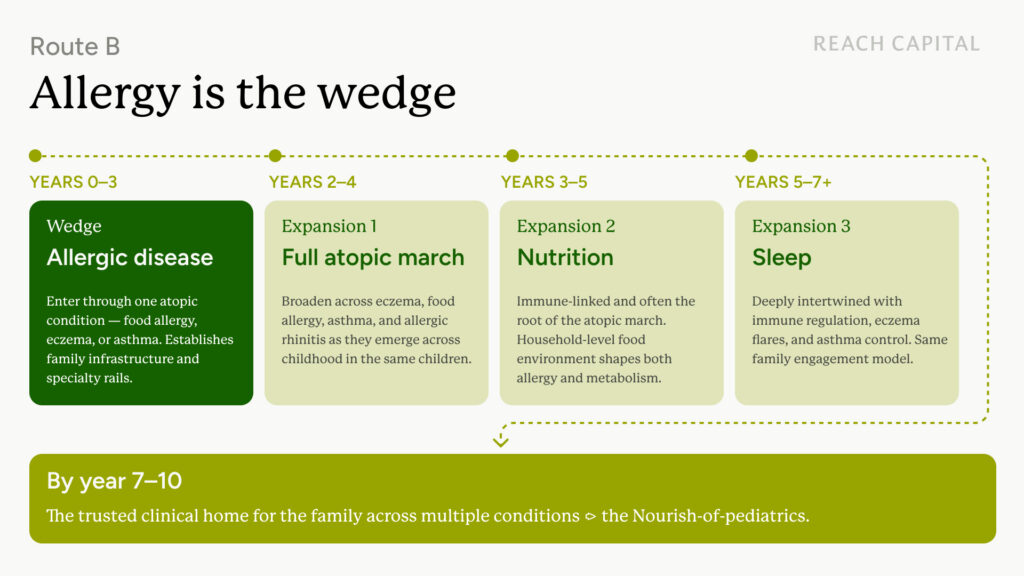
An allergic-disease wedge could expand across the atopic march, then into adjacent needs linked by immune biology and household environment, including nutrition and sleep. As with metabolic health, the specific path would depend on the family panel.
There is no clear leader among digitally native pediatric allergy companies. Established brick-and-mortar operators demonstrate demand and some commercial viability, while adult-focused companies such as Nectar, Curex, and Wyndly have shown that telehealth-based sublingual immunotherapy and environmental allergy management can support venture-scale businesses. Yet no digitally native equivalent has emerged at scale in pediatrics.
The opportunity is not simply a virtual pediatric allergy clinic, but a company that organizes care around the family: enrolling parents as clinical participants, designing plans at the household level, and measuring outcomes across the family unit.
Two Routes, One Platform Thesis
Metabolic health offers a proven family-based protocol ready to scale; allergic disease offers the chance to define the protocol and build the evidence. Both are attractive condition-specific wedges into a broader family health platform that we’re actively exploring.
If you’re building along either route — or think we’re missing another — find me at jomayra@reachcapital.com or on LinkedIn.
Read the Latest
News and Insights