The Family as Patient: Investing in the Next Wave of Pediatric Health
Many pediatric care companies today make a quiet assumption: the child is the patient. It maps to how healthcare has always been organized: one patient, one chart, one clinical encounter.
However, it doesn’t map to how children actually get sick, or how they recover. A 12-year-old with obesity does not develop it in isolation. It happens within a household that shapes what she eats, how she sleeps, her physical activity, and the ambient stress she absorbs. Then she gets treated inside a system that sees her for 30 minutes and sends her back to the environment that continues to influence her wellbeing.
This is where pediatric care has been stuck for decades. And it’s why we believe one of the most durable healthcare opportunities over the next 10 years won’t be a better specialty clinic, but rather a company that treats the family as the clinical unit. After several months mapping the space and pressure-testing the thesis with founders and healthcare advisors, we believe the time to build that category-defining company is now.
What ‘Family as the Clinical Unit’ Means in Action
The clinical evidence is well-established. Forty years of randomized controlled trials led by Leonard Epstein at the University of Buffalo have shown that when the parent is treated alongside the child in pediatric obesity cases, outcomes are significantly better than treating the child alone. In 10-year follow-up data, 34% of children who entered treatment at ages 6–12 reduced their excess weight by at least 20%, and 30% were no longer in the obese BMI range. No pediatric obesity intervention has comparable durability data.
Equip Health has commercialized this approach for adolescent eating disorders — Family-Based Treatment (FBT) via the Maudsley model, now the gold-standard treatment for anorexia nervosa. Equip is in-network with major commercial payors and produces clinical outcomes that consistently outperform individual therapy. The parent is enrolled as a clinical participant with her own treatment plan, care plans are designed at the household level, and outcomes are measured across the family unit.
The question we’ve been asking is whether the same model can be applied to other pediatric conditions with even larger addressable populations. We believe the most compelling version of the family-as-the-unit thesis should meet three properties:
- Condition-anchored. The company organizes around a specific pediatric clinical condition, not a broad suite of primary care needs. This creates clinical depth, defensible outcomes, and clearer, condition-specific reimbursement conversations.
- Family-based treatment is consequential. Treating the family—with the parent as a clinical participant—either demonstrably outperforms treating the child alone or is strongly supported by the way care is delivered. Epstein-model family-based obesity treatment and Maudsley FBT for eating disorders are the canonical examples; in other conditions, the opportunity may be to codify the protocol and generate the evidence alongside it.
- Wedge-to-platform potential. The chosen condition creates a natural on-ramp to adjacent family clinical needs—through shared biology, shared household drivers, or shared care infrastructure—so the initial wedge can extend into a broader family health platform over time.
What Exists Today
When we mapped the 40+ pediatric health companies operating today, we found that none have met all three properties and achieved scale. A handful of well-funded, early-stage companies clear part of the bar.
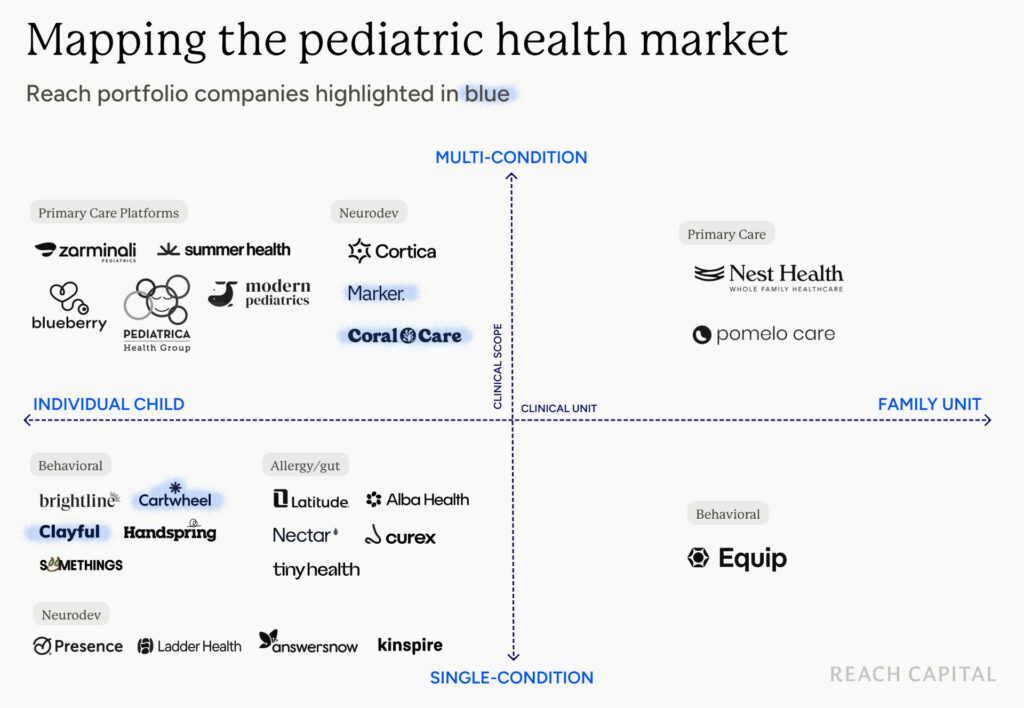
Nest Health ($22.5M Series A) is building an in-home, whole-family primary care model for Medicaid families, with a care team spanning pediatrics, adult primary care, behavioral health, dietitians, and family advocates. While Nest genuinely treats the whole family, its program is organized around the breadth of primary care rather than depth in any specific condition where family-based treatment has an evidence base. We’re looking for companies that start instead with successful condition-specific clinical outcomes, then earn the right to expand.
Pomelo Care ($171M raised, $1.7B valuation) has scaled a virtual maternity-and-infant care platform covering 25 million lives and announced pediatric and midlife expansion with its January 2026 Series C. Pomelo’s mother-infant clinical dyad is family-based within maternity; its trajectory could reach the broader family health platform from an adjacent starting point. It clears criteria 2 and 3 within maternity, and its extension into pediatrics will test whether it can clear the first.
Ladder Health and Kinspire, along with Handspring’s parent-coaching layer, are earlier-stage caregiver-activated models that include parents as therapeutic partners between clinical sessions. They partially meet criterion 2, but the child remains the primary focus — promising signals that the parent-as-participant model is spreading, but not yet at its fullest expression.
Why Specialty-First, Not Broad Family Primary Care
We believe the most successful family-based treatment platforms will start in clinical specialties rather than broad primary care, for the following reasons:
Clinical evidence is condition-specific. Clinical trial evidence for family-based treatment exists for specific conditions—obesity, eating disorders, and, more recently, pediatric anxiety. There is no comparable clinical outcomes evidence for “whole-family primary care.” A specialty-first company can point to a defined clinical protocol and outcomes data; a broad primary care company has to justify itself on coordination and access grounds, which is a softer story to sell to payors, employers, and the families themselves.
Reimbursement conversations are cleaner. Payors reimburse for the treatment of specific conditions against defined clinical protocols. Broad primary care requires per-member-per-month contracts that are harder to price, slower to negotiate, and dependent on value-based-care arrangements that have delivered inconsistently in practice.
Defensibility compounds through clinical depth. A specialty wedge with strong outcomes is hard to copy. A broad primary care model competes with every pediatric primary care company, plus every direct primary care company. Starting with depth, then expanding into adjacent conditions, is the route that we believe will produce platforms that can treat multiple conditions with real clinical moats.
What We’re Looking For
If you’re building at this intersection, here are the questions we’ll want to work through together.
Are you actually treating the family as the clinical unit? Is the parent enrolled as a clinical participant with her own treatment plan and outcomes tracked? Are care plans designed at the household level? Are sibling outcomes measurable? Are multiple parties engaged throughout the clinical process? And what does “family” encompass when there might be multiple households?
Have you built a model that can translate across pediatric populations? Pediatric family health is heterogeneous, spanning toddlers to teens and Medicaid to commercial insurance. Clinical needs and decision-makers shift meaningfully across those segments: a four-year-old is entirely parent-directed; a fourteen-year-old is increasingly the primary user. Medicaid populations may also require operational infrastructure that commercial-only companies rarely build, including transportation and language support, evening and weekend availability, and culturally coherent clinical content. We’re looking for founders who have designed the core model to flex across segments, even if the initial launch is deliberately focused.
What’s your entry channel and why? We have invested in companies that have started direct-to-consumer like Coral Care, B2B through schools like Cartwheel, and through self-insured employers like Goodbill. There is no right or wrong answer in how to acquire this user, but the entry channel and its implications for speed, scale, and incentive alignment should be fully understood.
In Part 2, we’ll examine two routes into the family-as-clinical-unit thesis: pediatric metabolic health and allergic disease. One presents an opportunity to scale a model supported by decades of evidence; the other, to help establish the family-based protocol itself. Both could provide a condition-specific wedge into a much broader family health platform.
Find me at jomayra@reachcapital.com or on LinkedIn if you’re building in this space, or have feedback on our thesis.
Read the Latest
News and Insights