Investing in the Machinery of Human Judgment
Professional judgment has always come bundled with time and labor. If you want someone’s expertise, you have to pay for their hours. Ask a civil engineer whether a crack in the foundation is serious, and you’re paying for the site visit, even if the answer takes just a minute.
AI is unbundling that package, with agents now handling much of the busywork around the clock. What they can’t do yet, though, is own the judgment call: the choice that doesn’t have a single right answer, but that someone has to make and take responsibility for.
Turning human judgment into something people can find, buy, and trust will require new infrastructure, one that lets agents take on routine work, decides when to hand something off to a person, and tracks who’s doing what. The companies that build it will sit at the center of how people and AI agents work together.
Every physical-world industry that runs on high-stakes decisions, from construction and insurance to healthcare, aerospace and global trade, will need this system of record. Each is an enormous market for human-AI work orchestration and labor augmentation, and that’s where we’re investing.
An Abundance of Execution and a Scarcity of Judgment
Today, more and more people can build customized software, down to the exact specification a job requires. Robotics and hardware will do the same for the physical world. The tools, services, and products available will multiply, and the cost of getting work done will fall.
Whenever technology makes something abundant, value flows to whatever is still scarce. When cloud computing turned servers into a commodity, value moved to data, distribution, and trust. As AI makes execution easier, human judgment becomes an ever scarcer and more valuable resource. The more tools and services there are, the more each call is worth.
Two forces make that scarcity worse. First, in skilled trades and other physical industries, experienced workers are retiring faster than they can be replaced. By 2030, over two million skilled trades jobs in the U.S. could go unfilled, at a potential loss of $1 trillion per year. In 2025, nearly 600,000 such jobs were posted, while only about 150,000 new workers came in through apprenticeships.
Second, in regulated markets, someone still has to be on the hook. A building permit needs a licensed engineer’s stamp. A prescription needs a pharmacist’s sign-off. Agents can prepare the work, but regulators, courts, and insurers need a person legally responsible for the call. This isn’t changing anytime soon.
Unbundled from labor, judgment will become a resource in its own right. This is what economists call a factor of production. Every major resource in history has eventually grown an entire economy around it. Take capital: banks supply it, payment rails distribute it, auditors certify it and stock exchanges trade it. Each became an enormous industry, home to some of the world’s most valuable companies. Human judgment will need the same machinery.
The Machinery of Human Judgment
AI agents started with well-documented tasks, like filling out forms and answering FAQs. They are also acquiring tacit knowledge that is rarely written down. Goodbill, for example, combs through medical records and claims for billing errors that experienced reviewers learn to spot over years. When there’s a right answer or outcome, practice can get AI there.
But real-life work is full of situations no training data covers. An AI agent can learn every step of a home-care visit: the medication schedule, vitals to log, the care plan to follow. Yet when an aide arrives and her patient seems off, is it a reaction to new medication, a diet change, or the start of a stroke? Does it require a call to the family or an ambulance? No amount of data can settle that. A licensed nurse has to make the call, and fast.
That’s where the machinery of human judgment comes in: tools that capture know-how in the flow of work, route it to the people and agents who need it, and certify it so others can trust it. These tools will also make human expertise something that can be bought and sold. Back in the patient’s home, the aide’s agent sends the vitals and symptoms to an experienced on-call nurse, who makes the call and is compensated for that decision.
We’re actively looking at two categories of companies behind this machinery:
1. Vertical AI Agents: software working alongside people
We continue to invest in vertical agents in physical-world industries where decisions require a licensed professional or carry legal liability, and where software is outdated or nonexistent.
In last-mile delivery, VoiceERP puts a voice agent in the cab with licensed drivers, coaching them in real time and handling snags that used to land on a dispatcher’s desk. In healthcare hiring, Take2’s AI interviewers verify certifications, run first-round interviews, and route qualified candidates to a manager for hiring decisions. In telecom, Lablabee’s agents simulate deployments to test network infrastructure, so technicians can catch errors before they reach the field.
These agents carry the day-to-day load in jobs that are hard to staff, while people make the decisions that matter. This is augmentation at work, and the result is a flywheel: workers show agents how they make judgment calls, and the agents pass that knowledge to new hires. Over time, this loop creates a system of record for how a company makes decisions, one that doubles as an audit trail for regulators.
2. Physical AI: machines doing the work people can’t, or shouldn’t
As physical AI models, sensors and batteries improve, robots will increasingly take on work that is dangerous, repetitive, or chronically understaffed. They’ll work alongside human crews who supervise and step in when something falls outside the script. These robots will become part of the labor force: staffed, scheduled, and priced like any other worker.
The physical world is full of edge cases that no training run covers: a damaged pallet or a weld that doesn’t look right. Each situation a person handles teaches the machine, and over time, the worker’s job shifts from doing the heavy lifting to making the calls.
Companies like Genki Robotics are developing humanoid robots for public safety and maintenance. Sira, which manages and schedules staff for security companies, is working to do the same for hybrid crews of people and robots. As robots take on the physical work, humans will be elevated into better-paid and more fulfilling roles.
Orchestrating How Humans and AI Work Together
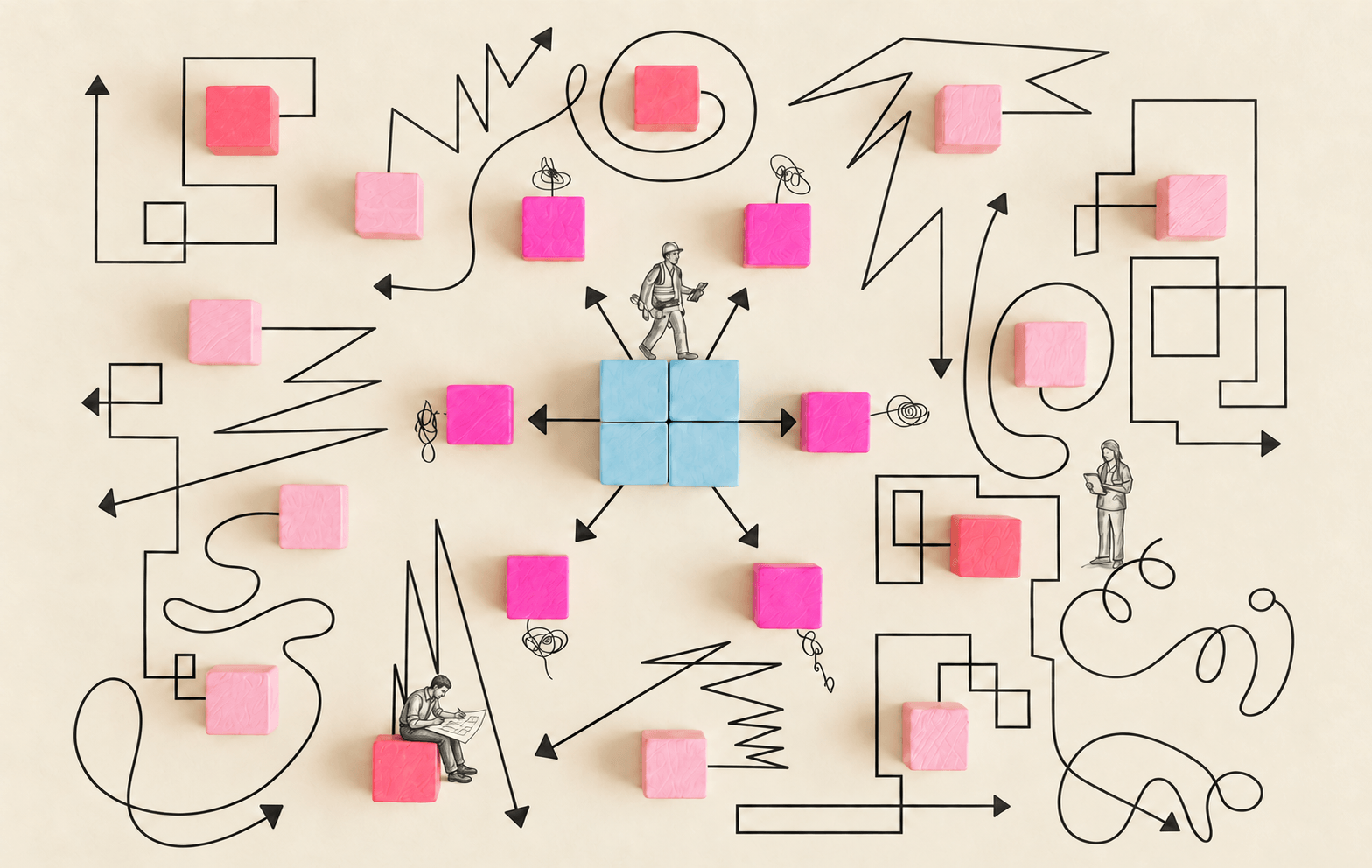
Both categories raise the same question: How will an agent or robot know when to act on its own, when to delegate, and when to ask a person? Put another way, what does the org chart of a human-AI company look like? The answer will differ by industry, but the companies that get it right will become the rails of the judgment economy.
Augmentation and orchestration are how AI will reshape work: not by replacing human judgment but by making it go further. For workers whose know-how has never been captured or properly valued, that’s a raise long overdue.
If you’re building here, we’d love to hear from you.
Goodbill, Lablabee, Sira, Take2 and VoiceERP are Reach portfolio companies.
Read the Latest
News and Insights