The Brain Science Behind Learning and Technology for Students
Part 3 in our series on the Edtech Backlash
In the first two parts, we recognized the legitimacy of the tech backlash in schools and revisited a history of blunt policy proposals that have emerged. We also made the critical distinction between student-facing edtech and software for teachers and administrators.
Here, we explore how developmental neuroscience research can inform a more nuanced approach to student-facing tech in classrooms.
—
Whether a screen helps or harms a child’s learning comes down to three things, and not one of them is whether the screen is in the room.
Across every technology shift, the evidence points consistently to the following conditions that shape whether it helps or hinders learning: developmental appropriateness, purposeful design, and adult mediation. None of these are new ideas, but they are more specific and actionable than the current debate has acknowledged. Together, they offer a guide more helpful, realistic, and durable than any blanket device ban.
What the Neuroscience Says
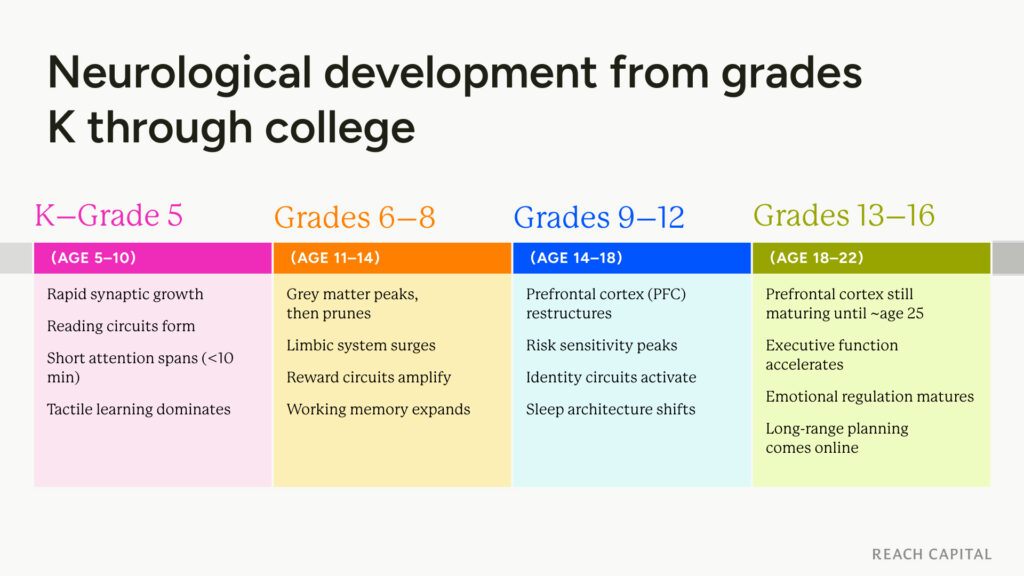
The four stages of development below are grounded in well-established neuroscience and offer relevant context for teachers and school communities as they shape technology policies.
Grades K-5: Laying the Grid
The research around ages 5 to 11 is among the field’s most robust, and often the least controversial. It tells us that brain development is like building a city, but with twice as many roads and connections as it will ever need. At this age, a child’s brain has far more connections than adults, before making choices in later years about which synapses get used and should remain, versus those that don’t and are pruned.
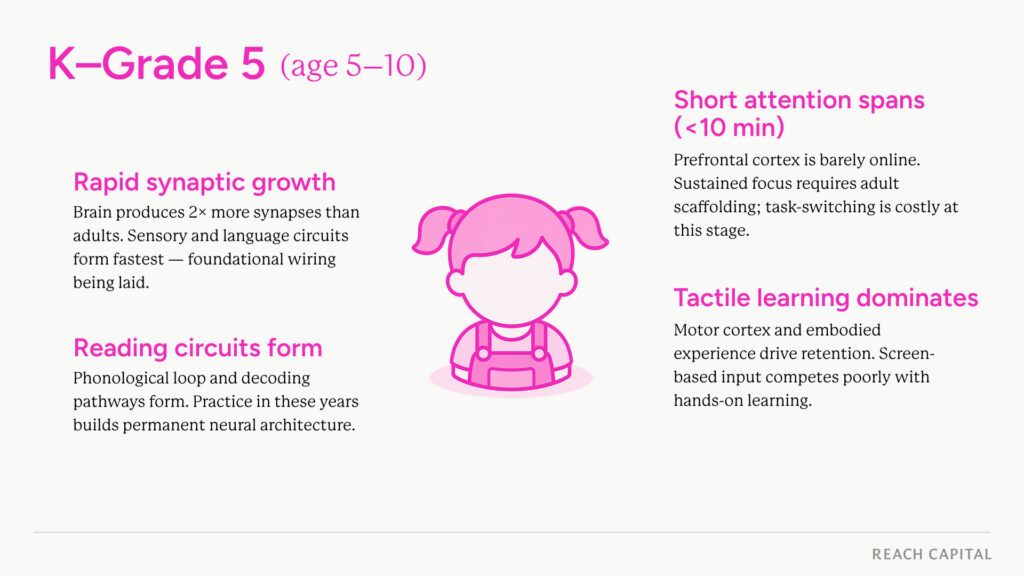
These synapses are the building blocks of neural networks that later support language, reading comprehension, reasoning and problem solving down the line. When we make decisions about how to deliver content and instruction at this early age, we aren’t just making pedagogical choices. We influence which connections survive, and which ones turn off.
When a first-grade teacher has students clap syllables, sort picture cards, or build words with letter tiles, she is giving the brain the physical, multi-sensory input it needs as the circuits are being built. The motor cortex at this age is doing real academic lifting. Physical movement and tactile experiences help build the pathways and memory that are the foundation of fluency. Math manipulatives from Lovevery and Innovamat are great examples.
Conversely, assigning prolonged digital exercises in front of a screen risks missing the sensorimotor inputs that are important at this age. Some touchscreen-based apps do incorporate tactile experiences designed around tracing, matching, and sequencing with finger movements. On the whole, the use of digital apps warrants caution and intentionality; oftentimes, paper, pencil, and reading aloud are better modalities.
While the brain’s map is still being drawn at this age, technology’s best role isn’t always to accelerate road construction, but rather flag when something has gone astray. A teacher who picks up on a student struggling to sound out simple words is witnessing a connection that may not have been built correctly in the critical window. Early intervention during this period is critically important. Tools like DIBELS and the EarlyBird screener represent where technology at this stage can be most effective: identifying where in the reading acquisition process a child is off track, so that a teacher can intervene while the window for building those circuits is still open.
Grades 6-8: Nurturing and Pruning Connections
The middle school years are when the brain starts to choose which connections survive. A sixth grade English teacher who assigns sustained reading and writing is investing in the higher-order language circuits that will survive pruning. Squeezing them out with extended rote activities lets them go unused, and tells the brain these circuits may not be worth keeping.
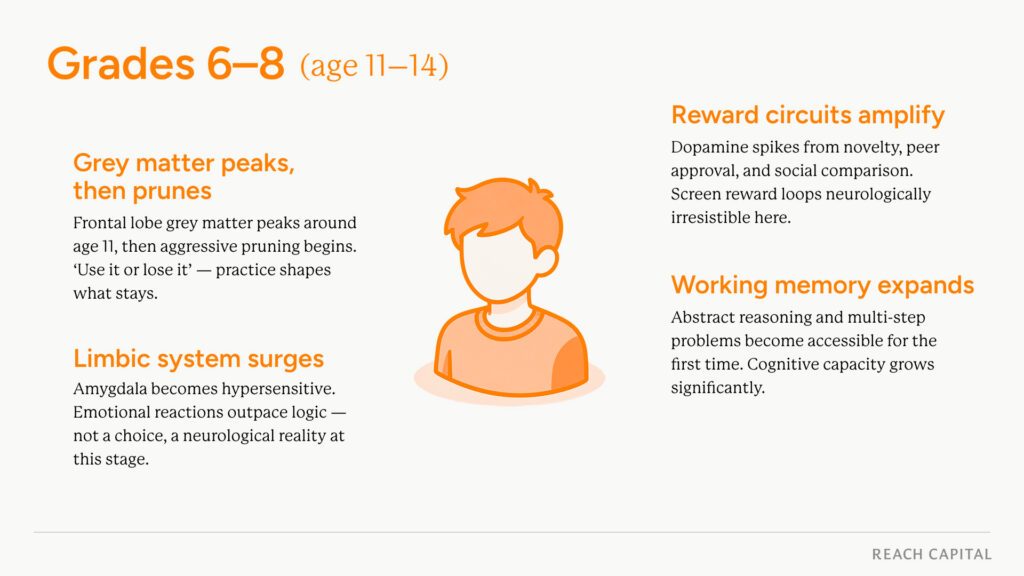
Compounding the challenge at this age, the part of the brain that controls emotion and fight or flight — the amygdala — becomes hypersensitive. How students feel seen and judged shapes their motivation and how learning sticks. Emotional regulation at this stage is more challenging, so feedback context and delivery is important.
Great educators know this. Feedback, delivered privately, with time for students to process before responding, is especially important for this age cohort. While technology is increasingly capable of doing this, what it cannot yet do is account for everything happening on the other side of the screen — the emotional pulse of a classroom, the developmental moment of a student — the way skilled teachers can.
Worse, some tools turn feedback into a competition: point systems, public leaderboards, competitive rankings between classmates. At an age when dopamine spikes from peer approval and social comparison, these artificial reward loops can distract and detract from the kind of focused, intrinsic motivation that durable learning depends on. These may drive “engagement” metrics that impress investors, but they contradict the needs of this age group.
At this phase, well-designed tools meet the brain where it is, pairing social development with deliberate practice that strengthens fluency. Programs that build emotional literacy, such as Yale’s RULER and Wayfinder, help tweens navigate the surge of complex feelings. Academically, this is also a prime window for consolidating foundational skills — particularly in math and reading — through adaptive platforms that provide targeted, personalized practice that help students develop mastery.
High School & College: From Connections to Creation
By high school, this calculus shifts. Students at this age have dramatically more processing capacity than they had in middle school as abstract reasoning comes online. The prefrontal cortex, where the planning, judgment and long-range thinking evolves, is still developing. Emerging executive function and impulse control means teachers often scaffold around routines, approaches to studying, and basic project management.
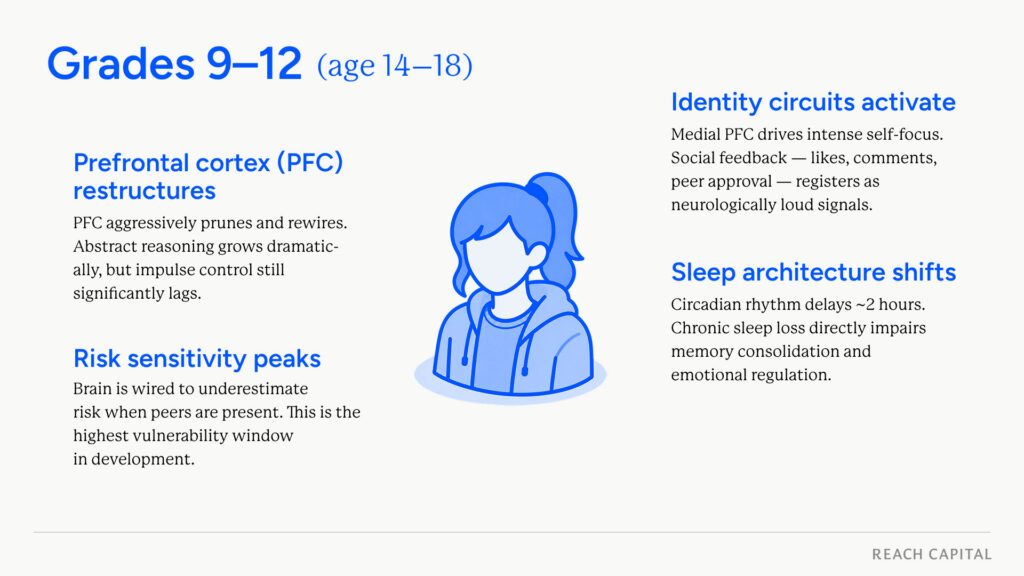
At this stage, teaching students to wield AI as a tool, and not a crutch, will continue to build upon the neural architecture formed in elementary and middle grades. The ability to ask good questions, critically evaluate machine-generated results, identify gaps, hallucinations and sycophantic replies — these all help buoy prefrontal cortex development. Those who merely take shortcuts to answers risk shortcutting those connections. Even as AI makes knowledge more accessible than ever, students should be challenged to think just as hard about the task at hand.
This is also a developmental phase marked by novelty seeking and risk appetite. The same neurological wiring that makes teenagers prone to impulsive action and pushing boundaries also makes them willing to experiment with new ideas and challenge the status quo. This is a great thing for learning!
When technology is thoughtfully woven into projects that align curriculum with personal interests, it can channel that energy into remarkable creations. Desmos’ annual art contest is a testament to how students can push the boundaries of what’s possible with math, art, and programming. On Replit, high school students have built apps to assist feminine health and natural disaster response efforts. Deployed well, tech at this stage isn’t just about teaching and learning. It encourages students to take intellectual risks and helps them discover what they are capable of building.
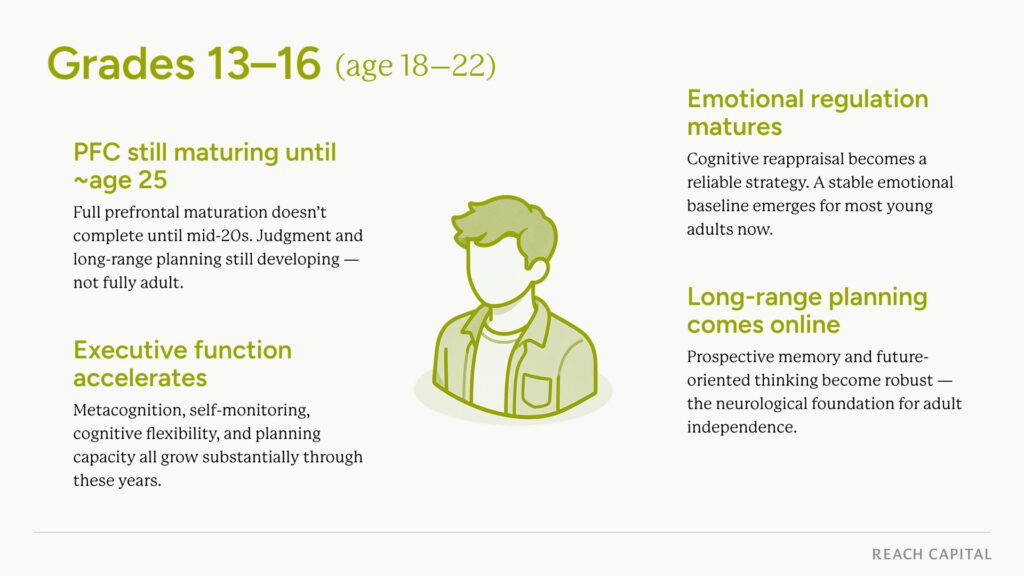
Getting technology right in the classroom has always come down to two things: meeting students where they are developmentally, and having a skilled teacher who knows how to design experiences around it.
In Part 4, we will dive deeper into pedagogical design and adult mediation, and weave all three conditions into a practical framework that school communities can use to square developmental milestones with technology policies that are grounded in decades of learning research.
*Desmos, EarlyBird, Innovamat, Lovevery, Replit and Wayfinder are Reach portfolio companies.
Select Research
Dehaene, Reading in the Brain: The New Science of How We Read (2009)
Gogtay & Thompson, “Mapping Gray Matter Development: Implications for Typical Development and Vulnerability to Psychopathology,” Brain and Cognition (2009)
Pfeifer et al., “Longitudinal Change in the Neural Bases of Adolescent Social Self-Evaluations: Effects of Age and Pubertal Development,” Journal of Neuroscience (2013)
Steinberg, “A Dual Systems Model of Adolescent Risk-Taking,” Developmental Psychobiology (2010)
Read the Latest
News and Insights