How Reach Invests in Math, Wherever Learning Happens

Math has long been a core investment focus for Reach. Math achievement directly impacts future earnings1. This is fundamentally an equity issue: when children are deprived of high-quality math instruction, career opportunities are shut down.
Today, far too many students lack the math education they deserve, leaving them without foundational skills to pursue careers in STEM. The insidious effect is that many students internalize the belief that they’re somehow innately “bad at math” and, as a result, close the door on entire career pathways — often the best paying.
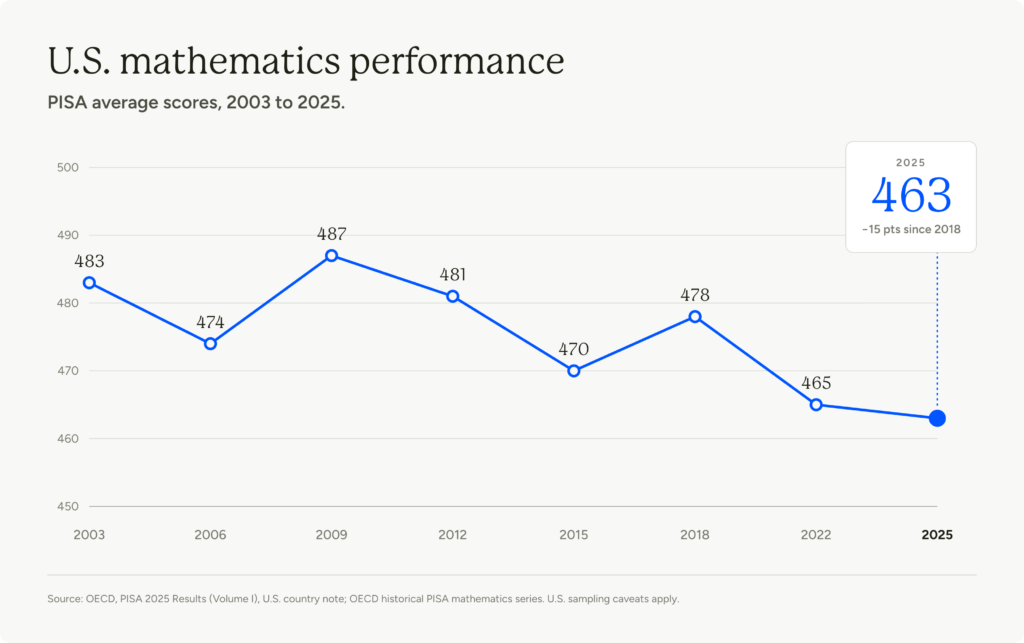
In the U.S., math education is a perfect storm: a lack of evidence-based curriculum, a massive and underreported math teacher shortage2, little math preparation in teacher ed programs3, a culture of fixed mindset around math learning, and more. It’s not surprising that PISA math scores have declined since 2018.
For these reasons, we’ve invested consistently since Reach’s beginning. We don’t believe in a silver-bullet fix for math achievement. It starts early: with tactile toys that build math intuition and tools that help parents support their children, and continues in school with evidence-based curricula, well-prepared teachers, and strong supplemental learning opportunities. And it goes beyond schools, with tutoring (AI-powered and human-led) that are accessible at home. This comprehensive approach has led us to invest across business models — SaaS, consumer, and teacher training.
Our consumer math investments run counter to what some education reform philanthropists espouse4, that funding should go only to tools for public schools. There are many school-based math programs in our portfolio. But schools are no longer the sole gatekeepers of learning — that changed when the internet became ubiquitous. Students learn outside the classroom, across all socioeconomic levels. It’s a mistake and frankly patronizing to assume that ambition belongs only to the wealthy. Many low-income families seek supplemental support, and direct-to-consumer tools are the lowest-cost way to supplement learning with proven math strategies, ensuring everyone has access.
The math crisis is urgent. Investors and funders can’t afford to wait for multi-year randomized controlled trials to run their course before acting, given how fast and powerful technology is becoming. Doing so risks losing another cohort of kids who have lost their confidence in math. Instead, back teams that prioritize research from day one, and build around clear, evidence-informed principles.
For example, when Eli Luberoff started Desmos, his focus on efficacy led him to bring on Dan Meyer, a Stanford-trained PhD and former math teacher, as Chief Academic Officer. And before Lovevery launched, Jessica Rolph pored over doctoral research to understand what truly works. The result: years later, Lovevery released one of the strongest early-childhood math kits we’ve seen, building intuition through numeracy and number sense. Innovamat grounded its innovative math curriculum on research, and their team of researchers guide both their product and the broader discipline today.
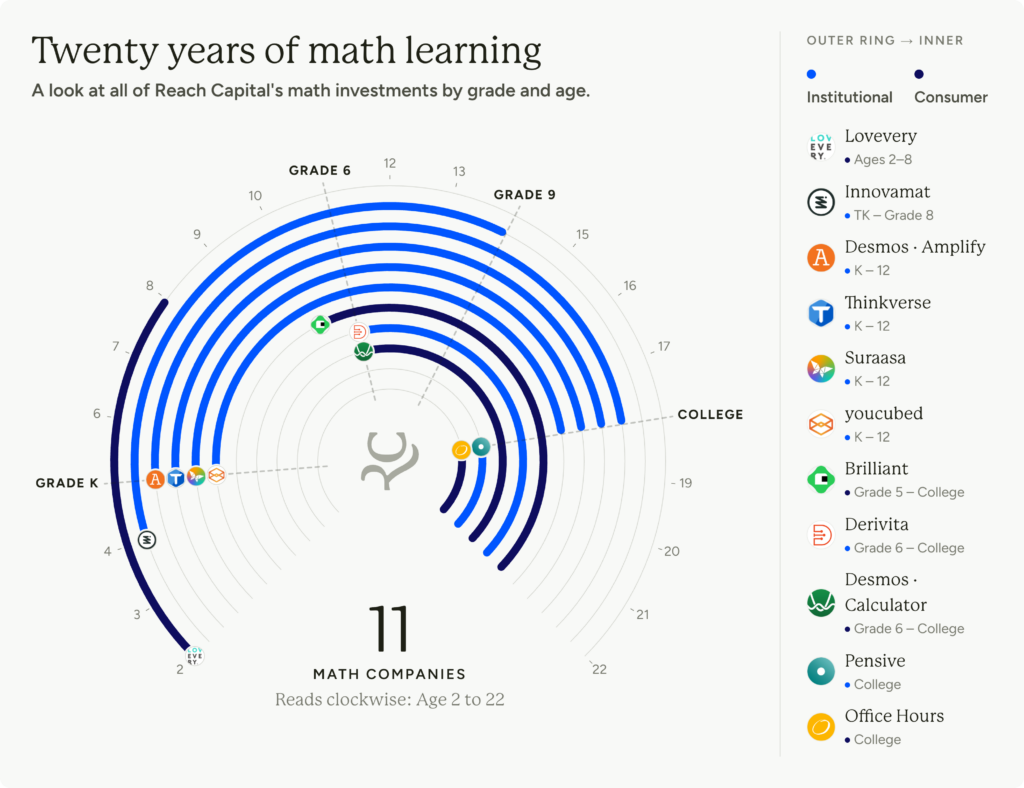
Over the past decade, we’ve invested in ten math-focused companies and are proud of the impact of this portfolio. These products span early childhood through adulthood, and are both beloved and demonstrably effective. Many are category leaders that we invested in even before they launched.
We continue to evolve our approach and look for new ways to address the math crisis. Two years ago we backed a company, Suraasa, that recruits internationally trained math (and special education) teachers to fill vacancies in the U.S. It has now placed over 100 teachers in U.S. school districts.
For Reach V, we anticipate more AI-native math investments. The underlying technology continues to improve rapidly, and AI will become an increasingly important tool for math learning. It is still no substitute for an inspiring and well-prepared teacher in a classroom environment of diverse minds, puzzling through math together. It’s magical to behold.
Footnotes
- Every point a student gains or loses on the national 8th-grade math test shows up years later in their paycheck. Harvard’s Tom Kane and Dartmouth’s Doug Staiger linked state NAEP scores to the adult outcomes of the students who took them. They found that a standard deviation improvement in a birth cohort’s 8th grade math achievement was associated with an 8 percent rise in income. ↩︎
- Almost every state reports a math teacher shortage and 1 of 3 new hires is not certified to teach math. ↩︎
- About 14 hours of foundational math instruction is what most teacher prep programs provide. ↩︎
- Philanthropy has long cared about math achievement. The Gates Foundation alone has granted more than $600M into the sector since 2023. ↩︎
Read the Latest
News and Insights