Designing the Future With Replit Co-Founder Haya Odeh
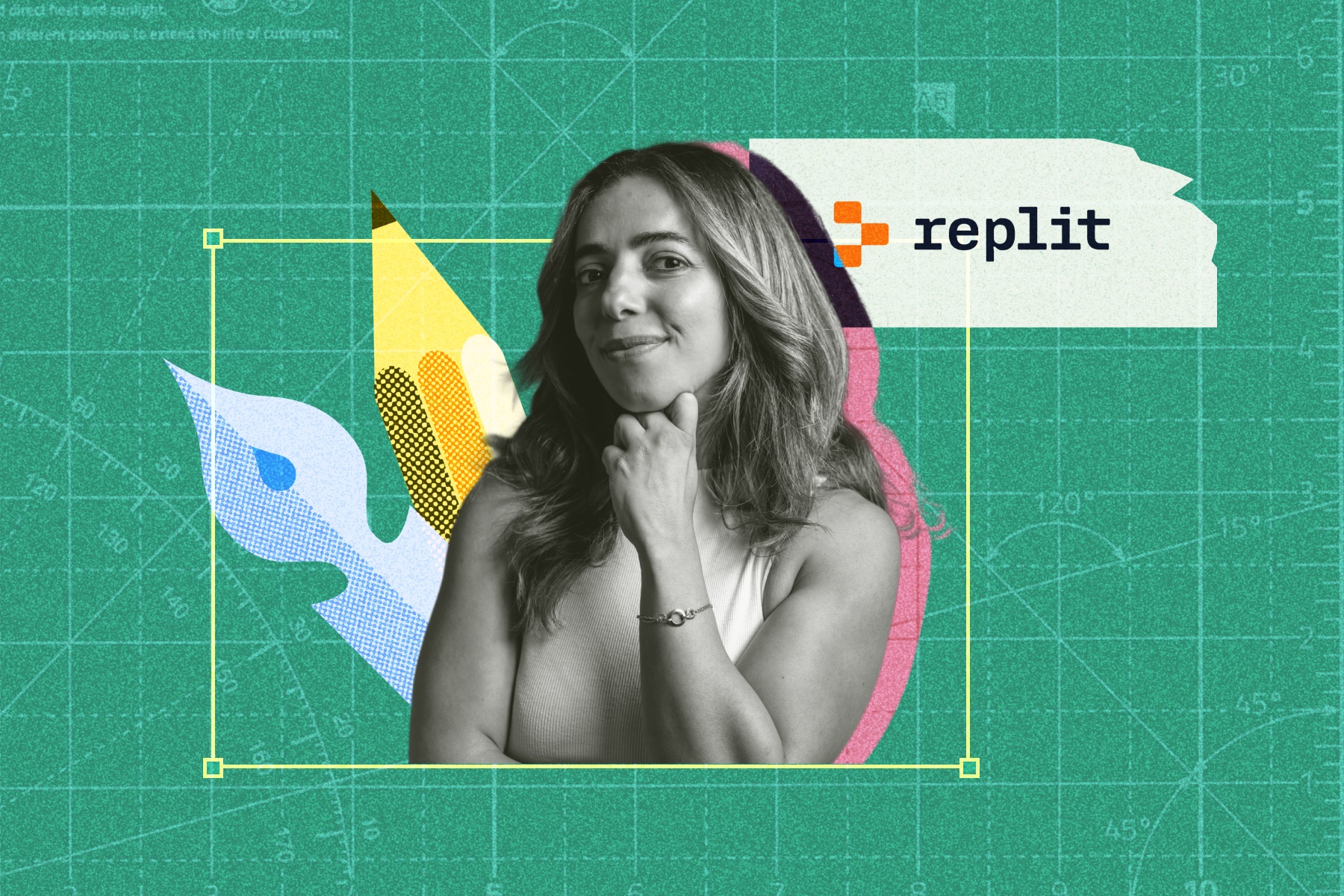
Growing up in Jordan, Haya Odeh loved colors. She has vivid memories of coloring and shapes as a child. Today, she’s the co-founder and VP of Design at Replit, one of the world’s most widely used platforms for software creation, with over 50 million users and five million apps created.
Replit started in 2016 as a tool for professionals. One decade and four AI Agentic evolutions later, it is now pioneering how anyone can build software. That transition didn’t happen overnight. It required thousands of intentional design choices — including ones as small as replacing the word “deploy” with “publish” — especially since most people don’t speak the language of developers.
Many of those decisions trace back to design instincts honed earlier in her career. In this interview, Odeh shares her path into design, how Replit’s design team has evolved alongside the product, and the obsessive attention to detail and “taste” — the kind that notices the difference between 1% gray and white — that she believes any great designer, at any stage of their career, needs to develop.
The Design Journey
Reach: What was your journey to a design career?
Haya: When I finished high school and was deciding on a major, my sister told me about a new major called graphic design. I learned all the fundamentals: drawing lines, shapes, light, shadow, architecture, interior design, typography, calligraphy, graphic user interfaces, websites, posters, branding…
After graduating, I worked on magazines and newspapers, designing ads and other things. I didn’t feel like I was tapping into my potential, though, so I started redesigning websites. At the time, I didn’t have the design language to fully know what I was doing, other than “I don’t think this site looks as good as it should.”
When I first met Amjad (Replit’s other co-founder, CEO, and her husband), he asked me to design the logo and UI for the first version of Replit. Then I followed him to New York, where I applied to jobs as a graphic designer. It felt a bit like the Hunger Games, with all the best in the world competing. It was daunting but I reminded myself of my strengths. I know two languages very well (English and Arabic), and came across something called internationalization design: How can you design for two audiences who speak two different languages?
I later found this course from General Assembly, called Introduction to UI/UX. For the first time, I felt like, “This is it!” If I had to describe the kind of designer I am, I am an experiences designer. I’m really good about things that make you feel good and how it makes you feel good.
In any career journey, it’s important to keep trying different doors to find your way.
What are some design principles that you consistently return to?
Haya: People can overcomplicate things, so I always like to simplify to what users really want. There are user needs, the business needs, and the brand goals. When a designer can synthesize these needs, they can find a sort of Holy Grail.
There’s a dialogue between a product and user, which establishes trust and expectations. What is on you, and what is on me? Sometimes, people want to put it all on the users to figure out, and that dialogue is missing.
I always come back to: Is it clear? Is it understandable? Do the expectations make sense? Who is doing what? Once these are clear, users start trusting the product more and more, and everything else will click.
Designing at Replit
Reach: As Replit went from focusing on developers to non-technical users, what was an important design choice to help that transition?
Haya: Language is very important, and small changes can make a big difference.
Back when we were focusing on developers, the product language was catered for technical people — terms like “deploy,” “object storage,” “fork.” When we started to expand beyond the core audience of developers, it took time to align everyone on the team around the new language. New users would see language they didn’t understand — words like “deploy.” (What does that mean, like are we going to the army?)
When we saw they were confused, we tested “publish” versus “deploy,” and “publish” performed much better. When we made this change, people created many more apps.
Even with today’s AI-powered tools, what remains a barrier for builders?
Haya: Not everyone understands what problems software can solve, and helping users figure this out has become an interesting design problem, as more and more non-technical people are now using Replit.
On our landing page, we’ve experimented with ways to help people who don’t know what problem-solving with software looks like. One of our designers tried to tackle this by creating prompts like: “I want to build an app or website for whom? To do what? And then what?” He had these sentences with gaps that users needed to fill in. We did that because we were trying to define problem-solving for users who were not familiar with the process.
To help people persist in their projects, we’ve also thought hard about: What are the things users need to know at the right time while they’re building? We believe in progressive disclosure — slowly but surely showing them the tools and things they need to know. But this needs to be done in a way that is helpful and not overwhelming.
What does the design team look like at Replit, and how has it changed over the years?
Haya: The way we build teams at Replit is like a gradient. It’s not siloed. We build skills that complement each other, and it makes collaboration and communication easier.
Right now we have eight product designers and one brand designer. Those product designers are split — three do UX and research, and four are more technical. We also have another function called design engineering, which is product engineers who are skilled in design.
Back in the day, design would sit and brainstorm with the engineers, and then I’d tell them, “You go do your thing, I’ll do my own thing, and then we’re going to get together and prototype it.” That flow is out the window now.
At Replit, individual contributors have a lot of autonomy. They sit together, make sure they’re all working on the right streams, and make decisions. They’re not waiting for leaders or managers to say how things should work, because they already have a lot of context and information about what’s working and what’s not.
We make sure we are all together in the office so we can have these hard conversations and brainstorms. It lets us move quickly. Sometimes decisions are made in the hallway, or over lunch.
What design tools does your team use?
Haya: Whether it’s sketches or prototypes, all our designers work in Replit. I made it mandatory for my team to dogfood our product.
It feels so good to see real prototypes come alive in Replit, versus looking at still pictures on Figma or other tools. It gives the designers more autonomy, and it makes the design feel more real when they can see something come to life themselves.
In remote work environments, sometimes the work that designers do can get lost in the details after they hand it off to the product or engineering to decide how something should work. That’s when you start to see things breaking.
In Replit, you can be so detail-oriented that you can go to the nitty-gritty detail. Designers can tell the AI agent, “I want that animation to happen.” And by the time they’re handing something off to engineering, the work is already so detailed that [engineers] don’t even have to wonder how to implement it.
Advice for Aspiring Designers
If you were to start your design career again today, what would you prioritize?
Haya: Letting my guard down, and understanding how to listen to people, took me some time, because the practices I had learned were “the designer is always right.”
Talking to people is important. And when you’re doing a lot of user testing and listening, people can take a bit before letting their guard down and giving you real feedback because they’re scared to offend you or the product. Feedback is such a blessing, and I wish I embraced that earlier on.
Another thing I would prioritize is trying to understand computers more. I took many development classes to learn how to code so that I could communicate with engineers. Now, do future designers need all of this? Maybe not; my passion is that with Replit they don’t need to know everything in such detail.
Still, it would still be good to have some knowledge if something went wrong. When you’re in a self-driving car, you don’t want to be relying on it without knowing how to drive. What if something happened with the software? You should be able to take the wheel. You should have some basic knowledge to solve some things yourself.
“Taste” is a word we hear a lot these days. How is good design taste developed in the age of AI?
Haya: AI can follow established design guidelines and systems, and it’s great that it can take these details off my plate. But I worry when new generations of designers take the fundamentals for granted. I’ve seen this with some young designers who don’t notice certain things, like the difference between 1% gray and white. Or when something is mathematically centered, but visually it’s not centered to the human eye.
Practice is important for any artist. The more you do something, the more you realize you like things in certain ways, and the more you discover who you are. And when you develop an obsession with high-quality work, small things that don’t work or seem off start to bug you. Taste is in the small, fine details.
Read the Latest
News and Insights