Announcing Reach V, Our New $265M Fund
At Reach Capital, we just raised our fifth fund, at $265M. With this, our Founders Fund II, and previous funds, we’re nearing $1 billion in assets under management. We’ll continue to invest at the early stages — pre-Seed, Seed and Series A rounds — in companies that uplift human potential and the systems that support them.
Even now, over a decade later, I get a little jolt thinking about starting Reach. We were given a shot, mostly by founders who had also been given a shot, decades earlier. With so much money flowing into startups, it can be easy to forget what a rare privilege it is to be given a shot, to be evaluated on your raw ambition and the originality of your idea. In most of the world, this is unheard of.
With this fund, we’ll invest in another 50 teams. Our previous four funds backed over 180 teams of founders, each of whom takes on enormous risks — to their time, reputation, finances, family, and relationships.
Risk is the hallmark of early-stage venture capital. It’s distinguished from other asset classes for its embrace of risk, which is built right into the business model. It’s common for venture funds to have loss rates of 65% as long as they have a power-law winner — a company that returns the fund.
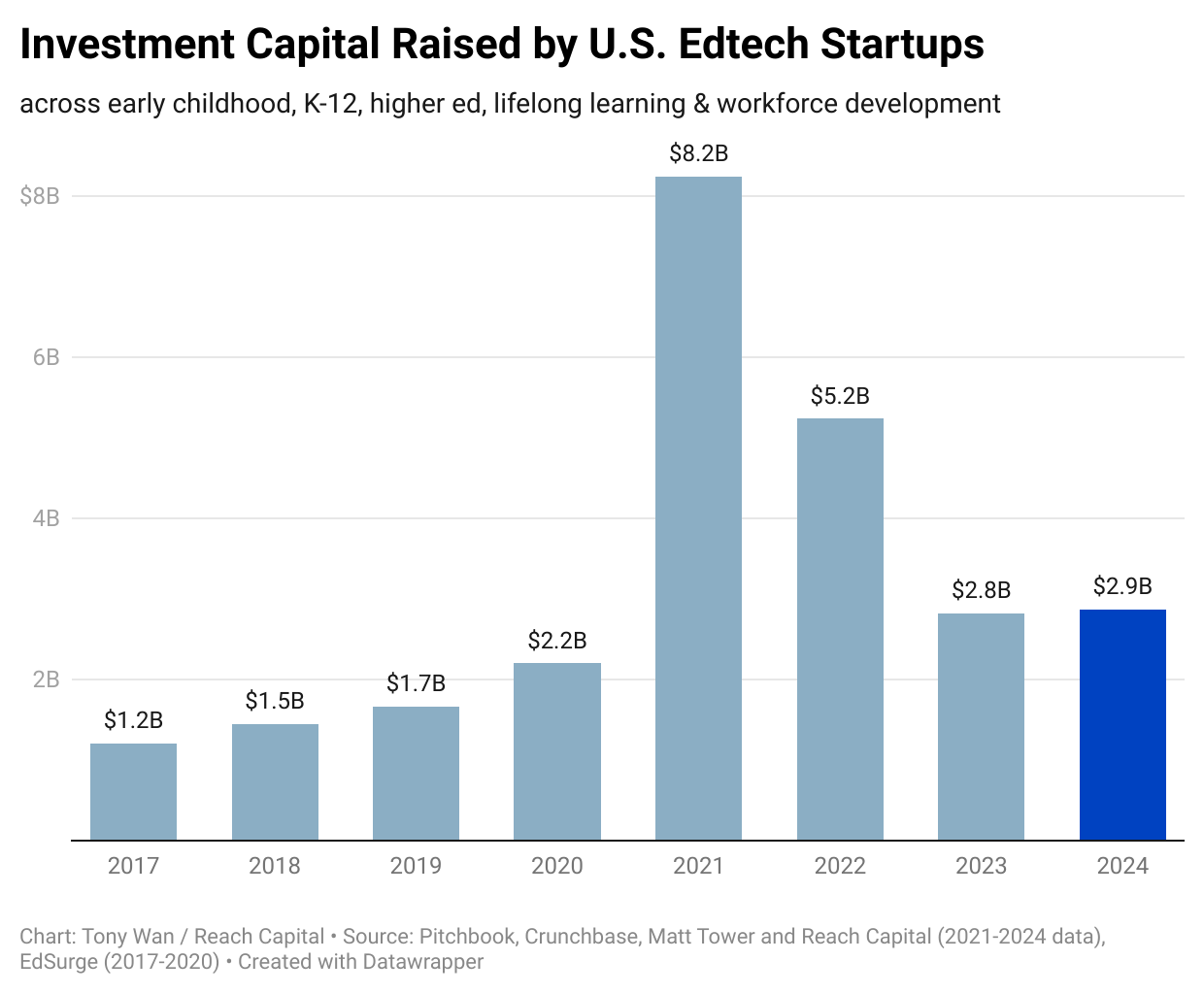
I can’t recall a time when venture capital was more power-law oriented than now, with so much capital chasing so few deals. Venture funding hit a new record in the first half of 2026, with $412 billion invested in the U.S. and AI companies capturing 86 cents of every dollar. Globally, two companies absorbed 43% of all venture dollars. Mega-rounds of over $100 million accounted for 87% of everything deployed in H1.
Investments are concentrating in frontier AI labs, creating power-law bets for a handful of funds. At multi-billion-dollar fund sizes, mega-funds depend on those rare outliers to drive their performance. The labs are the most capital-intensive bets the asset class has ever made and it’s looking like the returns will justify the concentration.
But a smaller fund size (<$300M) can have a different profile: a fatter middle of return distribution that accomplishes the twin goals of top-quartile performance and high impact. Let me unpack this with numbers from our first fund.
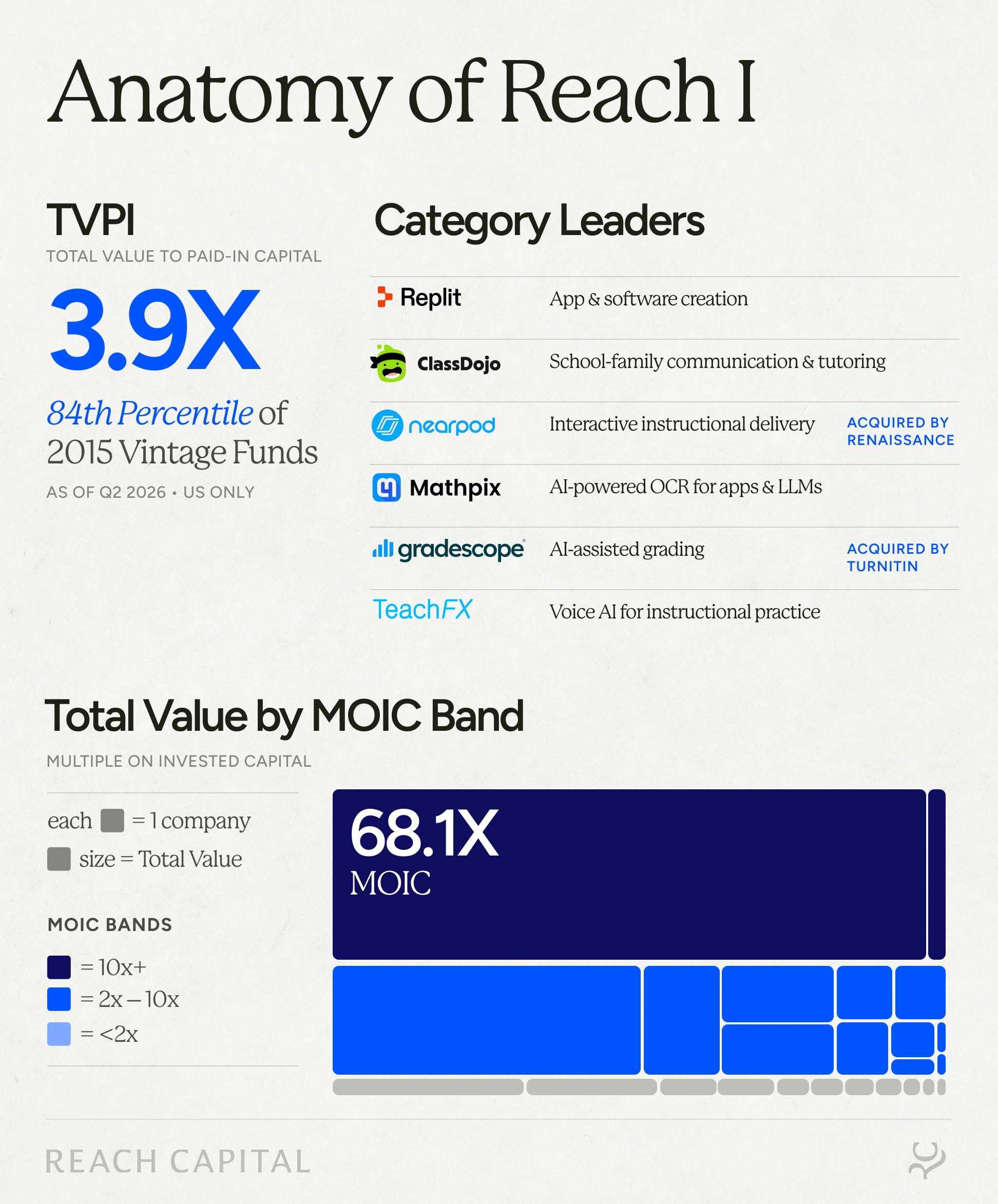
Reach I was a $53M fund deployed across 34 companies. It now stands at 3.9x TVPI (84th percentile in 2015 vintage). We have an outlier company at 68x MOIC, as well as a large segment of the fund’s total value that comes from a fat middle of 2-10x returners. The data below from actual companies illustrate this composition.
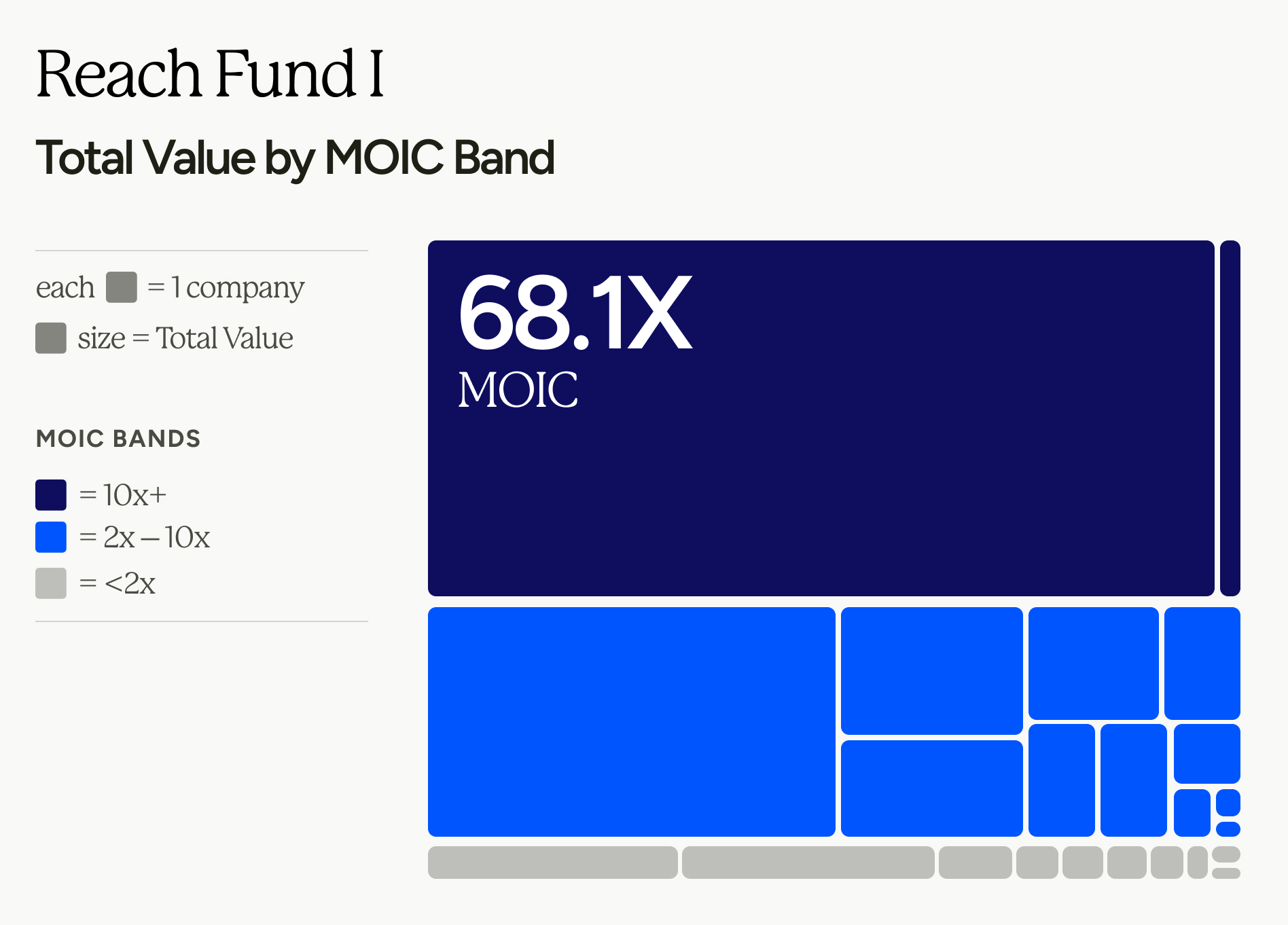
The companies in the 2-10x range serve more targeted markets. Gradescope gave professors and teaching assistants a way to grade and give feedback on assignments without drowning. Nearpod gave teachers the tools to make interactive lessons for K-12 classrooms. Both reached durable scale and then were acquired by market leaders (Turnitin and Renaissance) whose school relationships distributed the tools at a greater scale more quickly than we could have done ourselves.
Our second fund looks similar: 2.0x TVPI, a fund returner and a fat middle of exits in the 2-10x range. Our third is also shaping up this way. Companies with 2-10x outcomes are often acquired by strategic buyers on a more consistent timeline, and that has been the engine of our DPI, yielding top-quartile returns across every fund we’ve raised. The truth is: We can’t predict the power-law companies at pre-seed. Some started in narrow markets that evolved into much larger markets. Others built additional products that found new customer segments.
The largest venture capital outcomes tend to go to innovations that scale almost effortlessly — they often don’t require procurement, RFPs, training, or permissions. And we love these models too, for some markets. But teachers, nurses, plumbers and everyday workers operate within institutions where adoption is slow by design. This is not a bad thing; schools and hospitals are supposed to be careful with children and patients. It does mean they are harder to reach, and it’s why the companies serving them often return 5x instead of 60x. A 5x doesn’t move a multi-billion dollar fund, but it contributes meaningfully to a fund of our size.
Now more than ever, there is a case to be made for boutique funds backing founders who translate frontier technology into practical tools for the broader workforce. It’s the same thesis we began with. Eleven years later, we are still asking these questions: Can educators, scientists, hourly workers and small business owners benefit from the advanced innovations that the world’s largest companies have access to? How can we help create a world in which opportunity is more accessible to those who wish to go after it? These reflections led us to our current fund size.
Reach’s DNA is early stage. We love to partner with founders when they are just getting started and are seeking a believer, a partner, and a community. A market chasing only the biggest power-law outcomes will reach everyone who can be reached without friction. But I worry that this doesn’t go far enough to serve the people and institutions that could benefit the most.
History tells us that progress happens when technology stops being a privilege and becomes ordinary. An hourly worker who needed cash before Friday used to have one option: a payday loan with a 400% interest rate. Now she can get paid the day she works. A child who needed a therapist used to need a parent with insurance and time off and a car. Now he can see one down the hall from his algebra class. A high school graduate who wanted to become a phlebotomist used to need to quit his job and drive to the community college. Now he can do the coursework online. These are all made possible through technology and most importantly, by the incredible, risk-taking founders who wanted a shot to make it happen.
Reach is purpose-built for that founder. It’s the bet that was made on us, and it’s the one we’re still making.
Read the Latest
News and Insights