Revisiting 5 Stats That Are Testing Our Social Institutions — and Shaping Where We Invest

I’m revisiting the “5 Stats Shaping My Investment Theses” that I wrote about three years ago, in January 2023. While the pandemic is over, we have not returned to “normal.”
Instead, several lockdown-era trends have accelerated: families are looking beyond traditional public schools, young adults are socializing less, and educational institutions are under growing strain.
What’s emerging is a reordering of how Americans learn, work, connect, and contemplate their futures, challenging long-held assumptions about schools, careers, and community. These deep shifts signal a reallocation of time, trust, and agency toward individualized pathways.
At times I fear these changes are leading to greater isolation, fragmentation, and inequity. But institutional stress and disruption can also create fertile ground for meaningful innovation.
The opportunity lies in re-designing systems to be more personalized, without losing our essential humanity. As David Brooks observes in his farewell column for the New York Times, beyond the superficial pursuit of wealth and material gain in American society, a potent spiritual drive compels us toward movement, innovation, self-improvement, and a bold exploration of the future.
STAT 1: 1 million student decline in US K-12 public schools
Current Trend: 📈 ACCELERATING
Three years later, this statistic remains one of the central drivers of our investment theses.
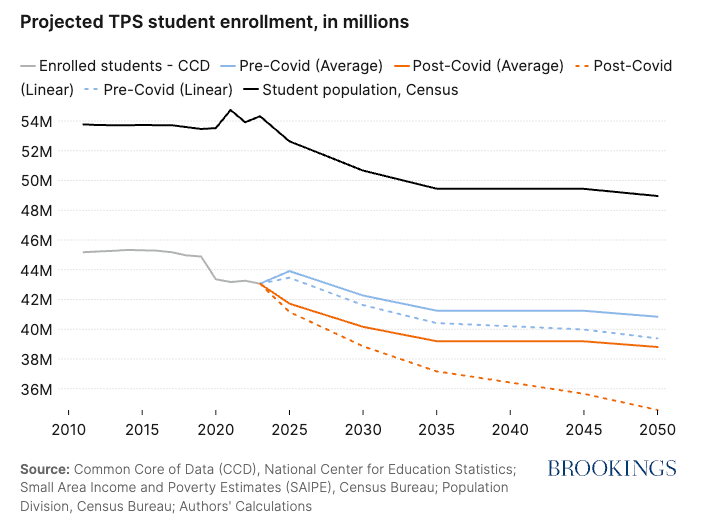
The anticipated post-pandemic rebound never arrived, and student enrollment declines have only intensified over the past three years. In New York City, public school enrollment dropped by 22,000 students in 2025 — the biggest one-year decline in four years. The loss means a significant revenue shortfall, as each student brings in about $35,000 from federal, state, and local funding. Last year’s decrease alone cost the city an estimated $770 million.
States such as Oregon and Utah are also reporting multi-thousand-student dips. Even Texas, despite experiencing a population boom over the past four years, is predicting a drop in public school enrollment over the next five years.
As traditional public school enrollments continue to fall, the Brookings Institute conservatively projects that districts will lose between 3 million and 6.5 million students by 2050.
The drivers are multifaceted. Lower birth rates are a major contributor, but shifts that started during the pandemic have endured. More parents are pursuing alternatives to traditional schools. This movement is fueled by:
- demand for more personalized, flexible learning tailored to each child;
- heightened identification of neurodivergent learners (roughly 1 in 5) and other learning differences;
- concerns about bullying and the broader social-emotional climate; and
- dissatisfaction with the breadth and relevance of available curriculum offerings.
This trend is not driven solely by the wealthy. Families across different socioeconomic levels began exploring nontraditional school options during the pandemic. In fact, the higher a district’s poverty rate, the greater the share of students learning outside the traditional system. High-poverty districts may have fewer private schools and fewer resources for homeschooling, yet they still experienced the largest absolute increase in students leaving the traditional system. Personally, this trend hits home. When I lived in Chicago, my local public school was failing by all measures. I was fortunate to attend a magnet school, but this option was open to few back in the early 90’s.
The historic shift of $13.3 billion in government funds directly to families is accelerating the growth of alternative school options. Over the past three years, the number of states offering Education Savings Accounts (ESAs) has jumped from eight to 18, with Texas — the largest to date — set to launch its program this coming school year.
Investment Areas: Our investments in this thesis aim to broaden the availability of alternative schooling choices for families. We’ve backed Kaipod Learning, Pathfinder, YourEdu, Scout, Cometa while also investing in tools to strengthen personalized learning across all types of schools: Teachshare, Ednition, Teachy, Paloma.
STAT 2: 35% fewer teachers enrolled in teacher prep programs
Current Trend: 〰️ STEADY
This trend has largely persisted over the past three years, though it has become more acute, particularly in the fields of STEM and special education. Every state in the country has reported teacher shortages ranging from severe to moderate, and 86% of districts report challenges with hiring enough educators. Teacher shortages are greatest in high-poverty districts.
A big concern is how few young people want to go into teaching. It’s hard to fault them: teacher pay has been largely stagnant for two decades, and they earn roughly 23% less than similarly educated peers. Many teachers themselves say they wouldn’t encourage their children to enter the profession.
But economics only partially explains the shift. As Teach For America founder Wendy Kopp notes [1], college campus recruiting cultures increasingly channel top graduates toward the “big 3”: consulting, finance, and tech. At Harvard, nearly half of last year’s class went into these fields, up from about a third a decade ago. Universities play an outsized role in career decisions, and many career centers operate on a pay-to-play model that privileges employers with the resources to invest early and heavily. The result is a recruiting ecosystem that elevates corporate pathways and sidelines public service roles like teaching, even at institutions that profess missions of broader societal contributions.
I plan to go deeper into this topic because we are currently overlooking a critical point. Teaching is a deeply meaningful and fulfilling profession, but perhaps more importantly, it’s a role where you cultivate skills that are becoming increasingly essential in the age of AI [2]. And very few jobs today offer this type of responsibility and leadership opportunities at the age of 22!
Investment Areas: We’ve backed this thesis with investments that directly address teacher shortages: Swing, a marketplace for substitute teachers; and Suraasa, which trains teachers overseas to fill U.S. teaching vacancies. (When I went to observe one of them, I was really impressed by her skills and how easily she’s been embraced by the community.) Breathe for Change is now offering an MA degree with a humanistic orientation. We’ve also invested in tools that help teachers manage their workloads including Journify, which streamlines special education paperwork and documentation.
[1] Highly recommend watching that Wendy Kopp’s keynote.
[2] For example, the ability to distill large amounts of information and prioritize, empathy, communication, planning.
STAT 3: The college gender gap: 60% women, 40% men
Current Trend: ➡️ STEADY BUT SHIFTING
This trend has continued and is now showing up in graduate schools, where women far outnumber men in law, medicine, veterinary and other professional programs.
In the last five years, the number of men enrolled in undergraduate programs has dropped by nearly a quarter of a million, and women account for 60% of undergraduate enrollment. Nearly half of women aged 25 to 34 have bachelor’s degrees, compared to 37 percent of men, according to the Pew Research Center [3].
Yet the story is more complicated than the data suggests. In the last few years, there has also been a sharp decline in the perceived value of college, and some would argue that men are early drivers of this trend.
Gallup’s latest survey found that only 35% of Americans think college is “very important,” down from 53% in 2019 and 75% in 2010. Just a quarter of adults think a four-year degree is key to getting a well-paying job, and nearly half say a bachelor’s matters less than it did 20 years ago. In late 2025, about 70% of Americans said higher ed is headed in the wrong direction, pointing to worries about price, relevance, and outcomes. Both men and women are rethinking whether college is still the default path to economic security.
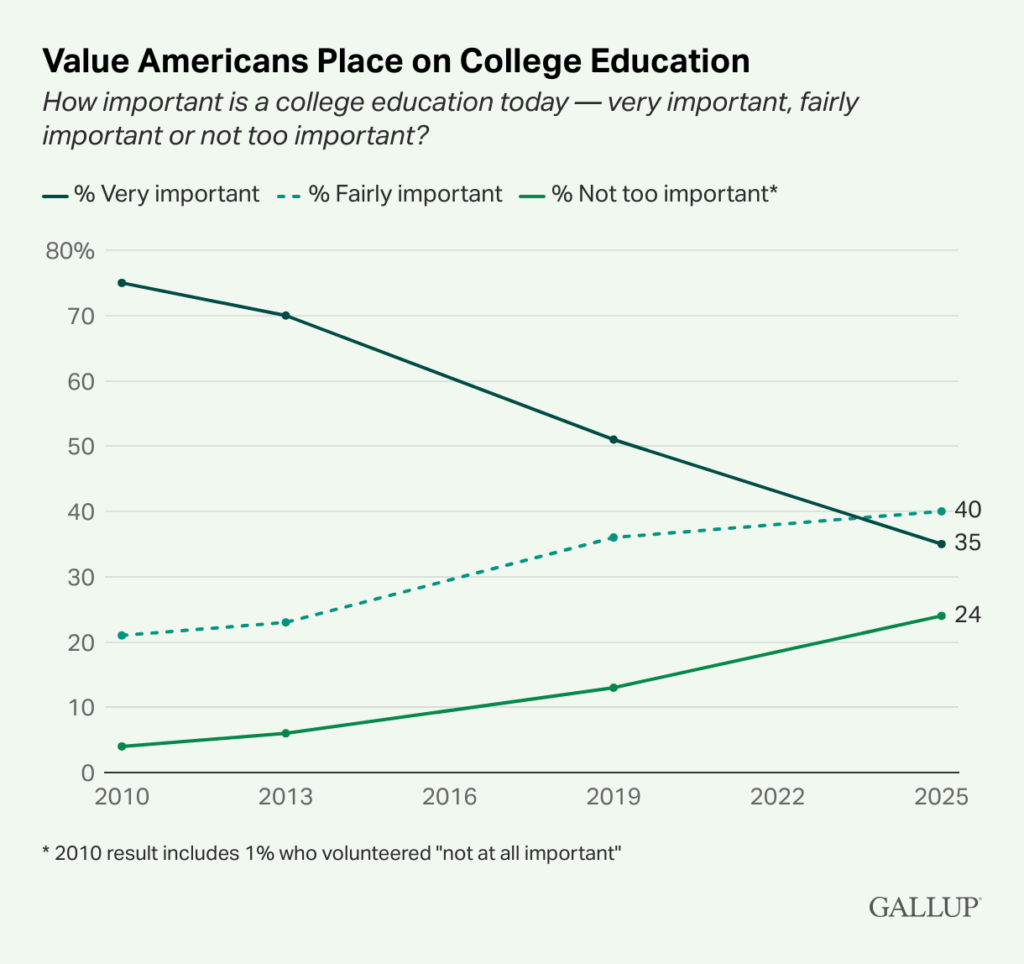
Weakening perceptions of higher ed’s value proposition muddles the signal around what the college gender gap actually indicates for young male wellness. For example, in a 2025 Deloitte survey, young men were far more likely to frame learning in terms of technical mastery and clear advancement pathways, while young women tended to emphasize credentials and stability, which may partially explain the gender gap. In other words, more men may be opting out to seek relevant, skills-first training programs that track more directly to labor market needs.
Entrepreneurship is another pathway men are seeking out, and tech founders in particular are getting younger, with many leaving college early or bypassing it entirely. Y Combinator, a microcosm of this ecosystem, saw the median age of startup founders drop from 30 to 24 years old between 2022 and 2025. About 75% of them are male, which mirrors our pipeline at Reach.
Investment Areas: We are sourcing skills-based training and apprenticeship programs that get people into the modern workforce much faster, and without loading them up with debt. These kinds of programs tend to have greater male engagement. Our investments include: Riipen, FourthRev, Major League Hacking, Stepful, Aprende, Springboard and CoderHouse.
[3] There is a lot of interesting data here around men scoring slightly higher on average on SAT test scores while young women have higher grades on average. Colleges have flip-flopped on use of standardized test score data for college admission and many more heavily bias grades as a sign of conscientiousness.
STAT 4: Just 5 weeks between the release of ChatGPT and its ban from NYC public schools
Current Trend: ↩️ REVERSED
This thesis has undergone the most significant change. After initially blocking ChatGPT on school networks, NYCDOE lifted the ban, acknowledging AI is both inevitable and has instructional value.
Other districts are following suit. In the last three years, many have developed or adopted AI frameworks to guide its use. It’s rare to see a blanket ban anymore. Three in 10 teachers now use AI weekly for tasks like lesson generation, feedback, differentiation and administrative work.
Most school districts now recognize that AI proficiency is a vital skill for students entering the workforce. The focus now is on acceptable student use of AI, especially around integrity, data privacy, and bias. A newish and growing worry is that students are outsourcing their critical thinking by over-relying on AI. Because this is now so easily done, pedagogy must change to address this new technology.
Overall, school districts are also increasingly adopting a more sophisticated approach to technology, focusing on tools that enhance student learning while minimizing those that cause distraction. A major indicator of this change is the enactment of laws and policies in 30 states that either ban or restrict the use of cellphones in schools. These enjoy broad public approval, with 74% of parents supporting the restrictions.
Investment Areas: At Reach, we see great potential in the use of AI to dramatically improve education at nearly every level. We believe educators will always have a profound impact on students, and have invested in teacher productivity tools: Teachy, Teachshare, Scout and Journify, among others.
We’ve been more cautious with student-facing tools but believe there is also great potential to accelerate, differentiate and personalize learning more effectively through the use of AI [4]. We’ve invested in Curipod which powers whole-class, social learning, and Snorkl, a platform for oral feedback and assessment. GPTZero is also growing rapidly as a suite of tools guiding the responsible use of AI in learning.
[4] See our other thought leadership pieces on school AI policies; “vibe writing” with AI, and our breakthrough ideas for AI-enabled learning.
STAT 5: American teenagers spend 11 fewer hours per week with friends vs a decade ago
Current Trend: 📈 ACCELERATING
This is a stat that many thought would recede after the pandemic, but instead it has continued to worsen. Three years ago I wrote:
“I’m eager to learn more about ideas that get at healthy habits for teens, explicit teaching of developing relationships and new ways of connecting that don’t leave kids feeling anxious.”
I’m afraid we’ve made little progress against this thesis.
In-person social time has declined even further for teens, who now spend even less time with friends than just a few years ago, and remain at historic lows despite the end of pandemic restrictions [5].
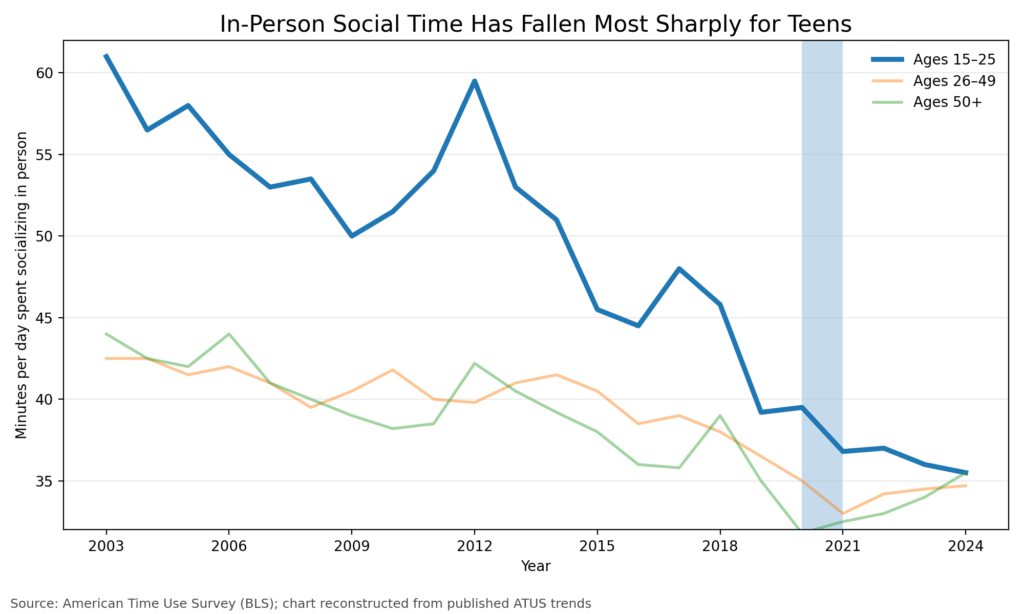
We’ve been tracking this data closely and believe this is a societal trend. As Anne Helen writes: the way we spend our time, whom we invest in, and what we prioritize is shifting. Solitude is becoming more than a preference — it’s becoming a default. There are real benefits, but when solitude drifts into isolation, the result isn’t just fewer friendships. It’s a fundamental loss of the ability to form and sustain them. If we don’t consciously reshape our priorities and re-learn how to cultivate meaningful relationships, we risk a future where connection — one of the most fundamental sources of happiness and well-being — fades into the background of our lives.
The potential reasons for this shift are too complex to cover here but this unraveling or redefining of our social fabric (depending on who you ask) is underpinning much of our investment approach. We look for those rare opportunities where technology can bring us closer together and elevate human potential.
Investment Areas: This reality has informed our investments in Lovevery and Wayfinder and more recently, Paloma and Digipals. Outside of our portfolio, we’re inspired by new dating app Known which is trying to move beyond the endless swipe cycle and help people actually meet in real life through a more thoughtful, AI-assisted process.
[5] From Time Use Data Surveys
Read the Latest
News and Insights